
No Pain No Gain
Is Nonsense on Stilts

A couple of months ago, our book club read Buckeye, by Patrick Ryan. As always, our discussion was lively and insightful, but I also couldn’t help noticing how every single one of us commented that it was a pleasure to read a book that wasn’t totally bleak and depressing. Hmmm.
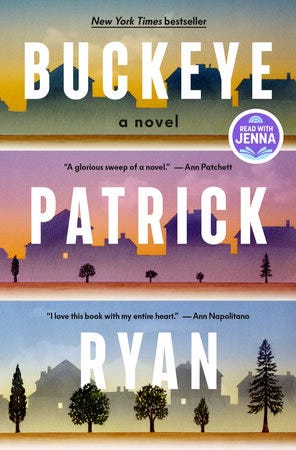
Buckeye deals with serious subjects—war trauma, abandoned children, family conflicts—but is also full of humor, satisfying reconciliations, and a plot that races along. Readers, I think you would love this book!
To Please and Instruct
One of my heroes, Samuel Johnson, believed that “The end of writing is to instruct. The end of poetry is to instruct by pleasing.” I think literary culture has lost track of the second half of this maxim. Otherwise why are the works that win all the prizes and that receive all the buzz in the elite media often so dark?1 And why are suspenseful plots and relatable characters considered déclassé? We honor works for their “beautiful sentences” (or, in the case of the book that won this year’s Pulitzer Prize for Fiction, single sentence), while we damn well-plotted novels with the faint praise of “light entertainment.”
To me the preference for beautiful sentences over thrilling plots is maddening, because it’s actually easier to write beautiful sentences than it is to construct a gripping plot. Think about it: To write beautiful sentences, you need a thesaurus (or Google); some alliteration, anaphora, and assonance (as well as other literary devices that don’t begin with an A); and the advice of this meme:
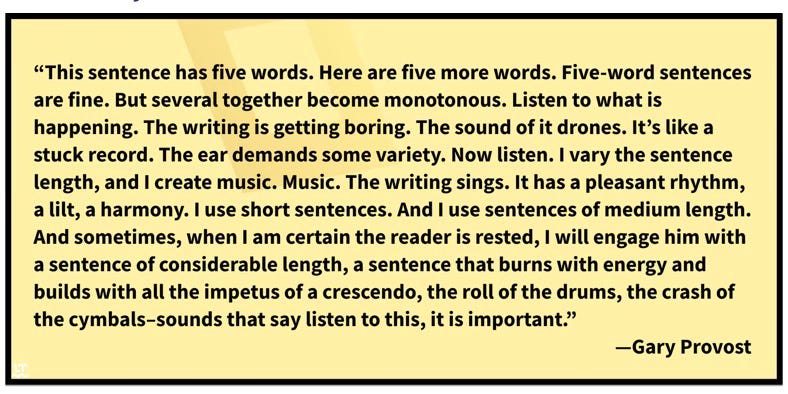
Now throw in some allusions, puns, and metaphors, and Bob’s your uncle.2
By contrast, to write a plot that gratifies and surprises us, authors must plan carefully, strew the story with clues as well as red herrings, and create characters who feel real and important to us. They have to construct a tricky puzzle and tell it in clean prose while simultaneously getting us to invest emotionally in the story. I’ll just say it: Agatha Christie’s achievements are more impressive than those of celebrated prose stylists like Ben Lerner,3 Lauren Groff, and that AI that just won a prestigious literary prize because of its “precise yet richly evocative language.”
The same goes for movies. As the author of the Technopoptimism Substack put it in a recent conversation,
My concept of what a great movie is has been radically altered. If you gave me the choice of re-watching any of the John Wick movies or most of the Mission Impossible movies (damn you Tom Cruise!) over, let’s say, a certain Very Important Film that is Very Timely from 2025 that is Oscar nominated, I know which one I’m choosing!
I feel somewhere along the line there was an internalization that Great Movies have to have some element of, for lack of a better word, pain to them.
The concept of revealed preference is helpful here. We may say that certain films are the best and most important, but what we actually choose to watch proves otherwise. For where our treasure is, there our heart will be also. We may admire Oppenheimer and willingly sit through the whole dang thing, but, to quote Johnson’s assessment of Paradise Lost, “None ever wished it longer than it is.” How many of us have watched Oppenheimer, and movies like it, more than once?
Now compare the movies we watch again and again. It’s these movies—which please as well as instruct—that are truly great. For me, it’s classics like The Philadelphia Story, Gentlemen Prefer Blondes, and Some Like It Hot, but also newer comedies like Clueless, The Wedding Singer, and Legally Blonde.
Readers, what is a movie you love and have watched many times?
DEAR Time
At the risk of sounding like a crotchety old lady, in my day schools did a better job of teaching reading. Teachers used to read aloud to us, all the way through sixth grade. We read whole books, for class and for fun. We chose our own books on weekly trips to the library, and our teachers would surprise us with DEAR time (drop everything and read). Reading for pleasure was a peaceful oasis for us. Nowadays, education experts apparently believe that pleasure reading is a waste of time. Schools rarely require students to read whole books and have switched to giving them bits and snippets. The curriculum focuses not on reading stories but on analyzing “informational texts.”
How can we best use that limited, precious instruction time to help kids become fluent readers? How can we help them learn to love reading, not just in school but for their whole lives? For answers, I turned to the wisest and most thoughtful reading expert I know, my mom. My mom spent her career helping kids read, first as a seventh-grade reading teacher,4 and later as an English teacher in a high school where most of the students were economically disadvantaged and/or from other countries. The students in my mom’s skills-based English class often had learning disabilities or were English language learners. My mom helped them pass the state reading examination so that they could graduate, but, more importantly, she
tried to foster a love of reading with a classroom library of books that interested the students. I would periodically preview some of the books by reading just a small selection to them to whet their appetites for reading one or more of the previewed books.
One year, my mom had a wonderful idea: What if her students could choose a free book they could keep for their very own? So she wrote a grant proposal and was awarded a grant that paid for the books, plus a bus to drive her and her students to and from Barnes and Noble. As my mom recalls,
Oh my gosh, they were so excited! It was one of the best days ever. They were very careful. They looked at a bunch [of books] and brought them to me and talked about them. They were learning to love reading. I had a student who had difficulties reading, and he read a Harry Potter book and was so proud and happy.
To help our kids become readers, my mom suggests “Reading aloud to them, and allowing them to choose to read what interests them.” I agree. We may want our kids to read literature, but what if they choose Diary of a Wimpy Kid or yet another truck book instead? It’s all good. Kids are more likely to read out of interest than obligation. And the more they read, the easier and more enjoyable reading will become for them, and the more likely that a love of reading will accompany them into adulthood.
Kids don’t want to analyze informational texts. They want to snuggle with a favorite grownup to hear a beloved book read for the umpteenth time, and to giggle and point out words their sleepy adult skipped. They want to get caught up in a story. They want to stay up past their bedtimes to finish just one more chapter. They want to curl up in a comfy chair and disappear into another world. They want to be inspired to create their own games, art, and stories. They want what we adults want: To choose books for themselves that they will enjoy.
Speaking of which, readers, what is a favorite book you recommend?
The Best Exercise
Fun fact: The first person to say “no pain no gain” was Jane Fonda, in her workout videos. Like “that beautiful mild woman” made famous by Yeats, Fonda taught us to believe “that we must labour to be beautiful.” And generations of trainers, fitness professionals, and health experts took a page from her book and now try to persuade us that we must suffer to improve our health. They tell us that the best exercise is strength-training (very important as we grow older), or running (gotta keep that heart rate up), or interval training (cardio and strength-training in a single workout), or—they will grudgingly allow—walking (for the rest of us slackers).
I have cycled through many kinds of exercise: Swimming as a child, biking in high school and college, running as a young adult, and yoga and Pilates with wonderful teachers and dear friends. All this plus Tae Bo (Tae Bo is a hoot; I am happy to see it’s enjoying a renaissance right now). My current favorite activity is hiking, for example through the Areuse Gorge last weekend:

You might have noticed that something is missing from this list: strength-training. I will never, ever, lift weights. To me it is far too boring, expensive, and painful. Counting reps, buying a gym membership or paying a trainer, working muscles to exhaustion . . . ugh. The gain is not worth the pain.

Let the experts fret that my refusal to lift weights will shorten my life and enfeeble me in the meantime. So be it. I prefer to follow the advice from Freakonomics: The best exercise is the one that you will actually do.
Readers, what is your favorite exercise, and why is it the best one for you?
I think “no pain no gain” gets it exactly backwards. Suffering mostly does not ennoble! We’re more likely to “gain”—a love of reading, strong muscles, or any other benefit—when we actually want to engage in the beneficial activity. So let’s rewrite the maxim: No pain! Enjoy and gain!
How about you, readers? Has “no pain no gain” worked for you? Or do you prefer a less strenuous approach to life? Please share your thoughts in the comments!
The Tidbit
Longtime readers know that I have beef with classical music concerts. I love classical music—listening as well as performing—but concerts? Not so much. Why do they have to clock in at two and a half hours or more? Why do they have to be so stodgy? Why must we sit silently in uncomfortable clothes? As with literature and film, so too with classical music: We think we’re demonstrating how much we value art by how much we suffer while experiencing it.
My husband, Matt, subscribes to a chamber music series, but I stay home, citing these gripes. I have had my comeuppance, though. Last month’s concert was a recital by a Polish countertenor, Jakub Józef Orliński, and according to Matt and a rapturous crowd, the concert was thrilling and also tremendous fun. Orliński is the opposite of stodgy; he actually did a handstand before performing his second encore. (And, as you’ll see in the video below, he is also quite easy on the eyes.)
I like to amuse myself by checking out the New Yorker’s Briefly Noted section each week and chuckling over how grim their recommended books always sound. Take the May 18 issue. Granted, one book, Transcendence for Beginners, chronicles the author’s spiritual self-discovery through reading books by Kierkegaard, Spinoza, and Proust, so it’s a bit brainy, but not bleak. The others though? Sigh. There’s an investigation of the human toll of the Trump Administration’s destruction of USAID; the harrowing story of a Palestinian refugee; and a memoir by the daughter of a Holocaust survivor.
To demonstrate how easy it is to use these literary devices, I sneaked in examples of alliteration, allusion, anaphora, and assonance, plus a couple of puns and metaphors. Can you find them all? Check back in a few days, when I’ll share the answers in a comment.
To be fair, I’ve read a couple of books by Ben Lerner and thought they were quite good.
Remember Newhart—the second Bob Newhart show, set in Vermont? Remember “Hi, I’m Larry. This is My Brother Darryl, this is My Other Brother Darryl”? The actor who played My Brother Darryl was in one of my mom’s seventh-grade reading classes!
Your mom's book story made me tear up. Books and reading are sacred. I hoard books with the excuse that if we ever go off the grid at least we have some entertainment.
And YES to the Wedding Singer. I love it for so many reasons ... except for Drew's refusal to trade in her 1998 fashion sensibility and embrace a true 80s style :) Now, please get out of my Van Halen t-shirt before you jinx the band and they break up.
I'm going to make a very brief attempt to convince you that weight training doesn't have to hurt to be helpful. You can do a program as simple as: a push, a pull, and a squat.
For a push I will suggest a floor press.
For a pull perhaps try a cross-body row.
For a squat do simple body weight squats into a kitchen chair - later on you can weight this and do a goblet squat.
Review and learn the exercises on YouTube or similar source.
Buy pairs of 5 lb, 8lb, and if ambitious 10 lb dumbbells or kettlebells - your choice.
Do 2 or 3 sets of 8 to 12 repetitions of each exercise. Use a weight that feels somewhat challenging by the last few reps.
Do this twice a week with maximum rest in between.
And that's it. This will take perhaps a quarter-hour twice a week. Doing a little bit is much better than doing nothing. Consistency is the key.
If later you want to add an exercise, the farmer's carry is wonderful for overall body strength. Also, as a weight bearing exercise it will help with maintaining bone density.
Okay, I've said enough and will get back to minding my own business.