
We Write for Readers
The Little Red Schoolhouse Method for Clear and Persuasive Writing, Part 1

Last week I argued that literature should both please and instruct. Put simply, if authors want their fiction to be effective, it should be enjoyable. The same principle applies to persuasive essays. If we want people to read our pieces, we should engage them with clear and concise prose. The sad reality is that if we force people to work too hard to follow our thoughts, we risk losing them altogether. We may have indulged our eloquence, but to whom?
I’ll admit my bias: When I was a graduate student in the early 1990s, I taught in a writing program whose fundamental principle is that we write not just to express ourselves, but to communicate to readers. The Little Red Schoolhouse (LRS) method was created in the 1980s at the University of Chicago by Joseph Williams, professor of linguistics and English; Larry McEnerney, senior lecturer in English and writing consultant to law firms and corporations; and Francis X. Kinahan, professor of English and professional stage actor. Over the years, dozens of graduate students worked as lectors, and hundreds of undergraduates took the course.

This week, we’ll start with a few general LRS principles and then close with the topic of the first LRS lesson every term, nominalizations. And be sure to come back next week to read about shortcuts, stress, “so what?” and much more!
Short King
One day, a student in my Greek Thought and Literature class turned in his paper, and I immediately flipped to the back page. He said, “Oh, you’re looking to see how long it is?” “No!” I replied. “I’m looking to see how SHORT it is!” My student’s mind was blown. He was used to churning out the verbiage, and it didn’t occur to him that any teacher would prefer a short paper to a long one. But I had dozens of papers to grade! The shorter the better! My LRS tutorials had eight students, who wrote a paper every week—and that’s in addition to the other classes I was teaching and my own sadly neglected dissertation. The only reason we lectors weren’t utterly swamped was that LRS essays had a strict three-page limit.
An underappreciated way we appeal to our readers, then, is to keep it short.1 Just as experienced hikers know that it’s actually tougher to go downhill than uphill, veteran writers know that it is more difficult to write concisely than it is to keep wittering on.
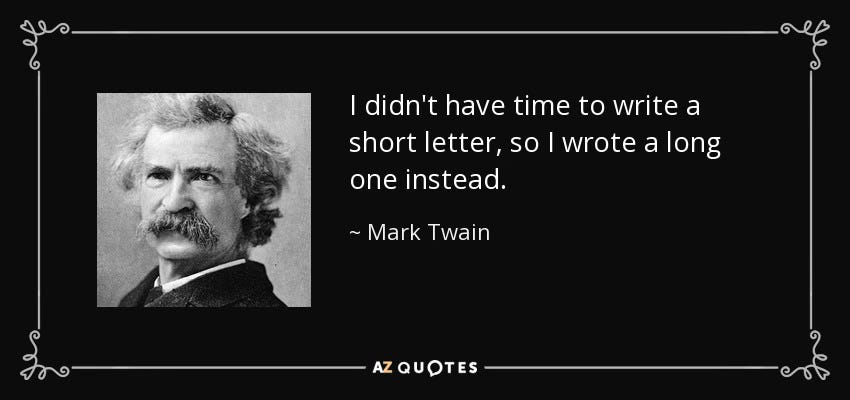
It’s worth the effort to tighten our prose. Think about it: Someone is going to have to invest their time in what we write. Either we take the trouble at the outset to omit needless words and kill our darlings, or we gamble that our readers are willing to be generous and stick with us. Concision is the way to bet.
Readers, have you ever decided not to read an article or book that looked promising but was just too dang long?
Don’t Preach to the Choir
A second way we write for readers is to make arguments that will appeal to them, even if they disagree with us. It seems obvious, doesn’t it? And yet many writers—not just students but professionals too—seem not to have gotten the memo.
To help my college students practice this skill, I had them write letters to the editor arguing that our neighborhood should allow more liquor licenses. I knew this would be a compelling topic because students were always griping that there were only three bars to serve a community of 50,000 people. However, there was a catch: The paper to which they were writing their imagined letters would be a community newspaper, and so their audience would not be their fellow students. It would be adults in the neighborhood who likely didn’t appreciate roving bands of drunken students. So my students discussed benefits like increased tax revenue, rather than how awesome it would be to have another hangout spot.
I also taught the LRS method to high school students. One day a student nervously broached the idea of arguing in favor of school vouchers, but he knew that I was the daughter of a public-school teacher and principal. I praised his moxie and added, “You have the perfect opportunity to write for a reader on the other side, and I know you will rise to the challenge.” He did!2 He was quite clever; for example, he pointed out that vouchers would reduce class sizes, which public-school advocates support.
Crafting an argument that will appeal to readers can be life-or-death, literally. As Rutger Bregman has noted, the British Parliament outlawed the slave trade well before other countries in part because English abolitionists didn’t preach against the evils of slavery. Instead, they emphasized that 20 percent of the white, English sailors on slave ships died on the voyages. The English might not have cared so much about enslaved people from other countries, but they did care about their fellow citizens.
Readers, have you ever tailored an argument to appeal to a person who disagreed with you on an issue?
Create Clear Thesis Statements
We also help our readers when we tell them at the outset what we’ll be arguing. Remember, our readers don’t have all the time in the world. Perish the thought, but some readers do skim, so we need make it easy for them to find and follow our main points.
We tell readers what we will be arguing with a clear thesis statement that
Is near the beginning,
Is interesting and debatable,
Is short enough that you could write it on an index card, and,
Appears right there on the page (as opposed to, “Well, what I meant to say was . . .”).
For example,
All happy families are alike; each unhappy family is unhappy in its own way.
It is a truth universally acknowledged, that a single man in possession of a good fortune, must be in want of a wife.
Airlines should make checked bags free, and they should charge passengers for carry-on bags that are too large to fit under the seat.3
Or, in today’s post,
We write for readers.
Effective thesis statements also guide readers through the argument by including key words that we will repeat in our topic sentences later on. Here’s the thesis statement of a paper our daughter, Casey, wrote for a college class:
Both “Prometheus” and The Vampyre deal with characters who must remain silent. However, while Prometheus’s dedication to remaining silent is both a product and a sign of his strength, Aubrey’s silence is enforced upon him, and therefore his silence is an expression of his powerlessness [boldface added].
In topic sentences throughout the paper, Casey uses the names Prometheus and Aubrey and the words “strength” and “powerlessness” (or close synonyms) to help readers keep track of the argument.
Readers, do you have an issue you would love to write about? What would your thesis statement be?
Nominalizations Are Energy Vampires
Time for some homework! Let’s translate some nominalizations! Whoo hoo!
We’ve all had the experience of reading turgid, bureaucratic prose that sucks the life out of us. The likely culprit? Nominalizations. They’re energy vampires.
A nominalization is an abstract noun that has replaced a concrete subject and active verb. For example,
A demonstration of the benefits took place.
vs.
We demonstrated the benefits.
The start of the class was an explanation by the teacher of the rules.
vs.
The teacher explained the rules at the start of the class.
We can quickly clarify our prose by translating nominalizations back into subjects and active verbs. Try practicing with the following sentences:
The implementation of the strategy was a decision by the management.
The investigation of historical sources resulted in a reinterpretation of the event.
Now, check out the nominalizations in the recall notice below. (This is a real recall notice that Joe Williams received.) What do you notice about them? What is this passage really saying beneath all the confusing verbiage?
A defect which involves the possible failure of a frame support plate may exist on your vehicle. This plate (front suspension pivot bar support plate) connects a portion of the front suspension to the vehicle frame, and its failure could affect vehicle directional control, particularly during heavy brake application. In addition, your vehicle may require adjustment service to the hood secondary catch system. The secondary catch may be misaligned so that the hood may not be adequately restrained to prevent hood fly-up in the event the primary latch is inadvertently left unengaged. Sudden hood fly-up beyond the secondary catch while driving could impair driver visibility. In certain circumstances, occurrence of either of the above conditions could result in vehicle crash without prior warning.4
These nominalizations defang words that are otherwise quite scary—“could affect vehicle directional control” instead of “you won’t be able to steer,” “heavy brake application” instead of “you won’t be able to brake,” and (Joe’s favorite) “sudden hood fly-up . . . could impair driver visibility” instead of “the hood could suddenly fly up and you won’t be able to see.”
In fact this recall notice is a brilliant piece of writing for its specific purpose: The lawyers who wrote this recall notice did not want readers to feel alarmed, or even to understand the notice at all. Their actual goal was to save the car company money by discouraging people from bringing their cars in for this free repair.
The exception proves the rule. If we’re writing recall notices, fine—nominalizations will help us soothe potentially expensive customers into submission. But for everything else, we’re better off converting those nominalizations into concrete subjects and active verbs.
Readers, do you have your own examples of amusingly confusing nominalizations?
How about you, readers? What are your tips for writing appealing prose? Please share your thoughts in the comments!
The Tidbit
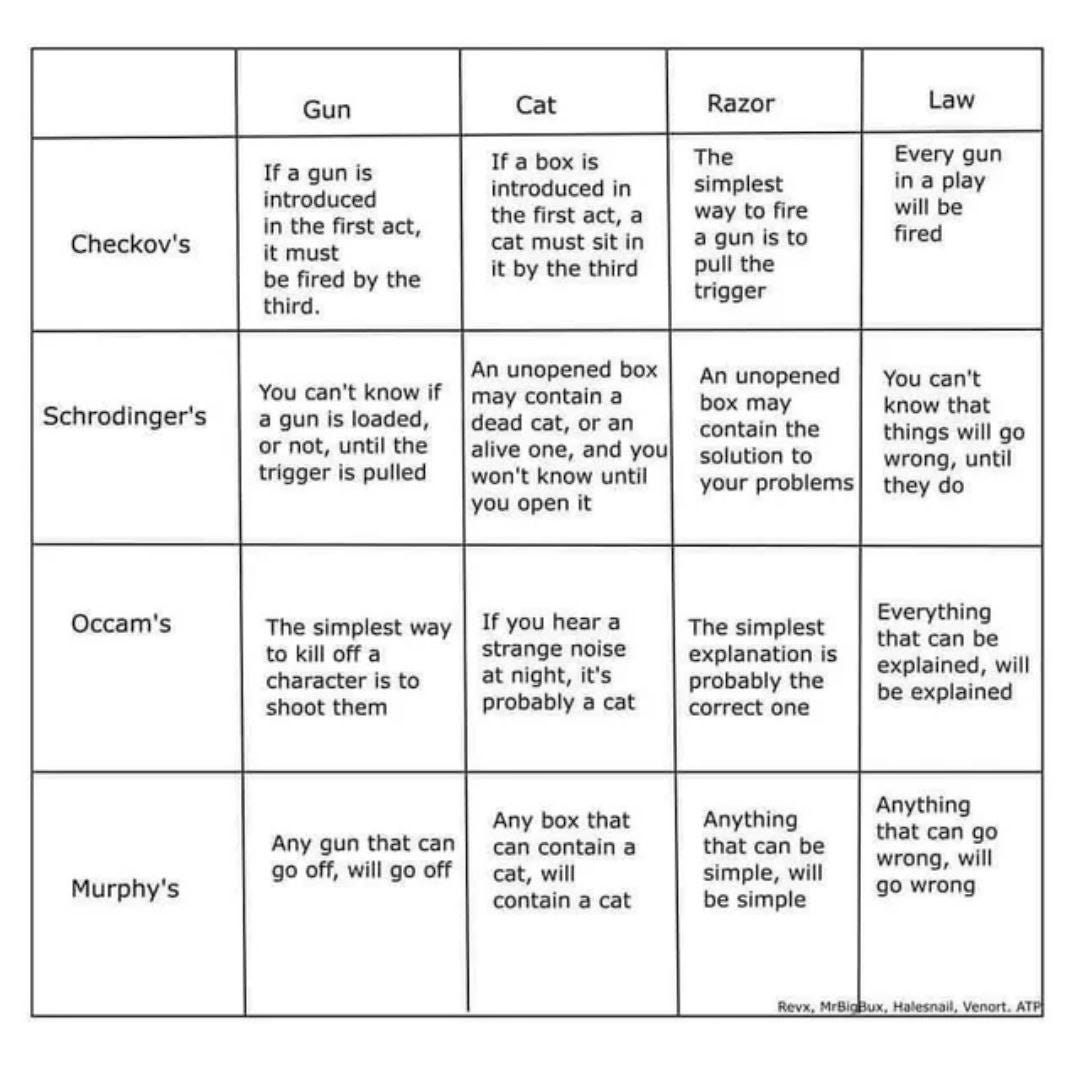
It’s also important not to mix our metaphors and allusions. So here’s a helpful chart:
I live by my principles! This essay was running long, so I split it into two parts.
Yes, he got an A, for the paper, and for the course.
One of my all-time favorite topics-- clear writing, clear thinking, and our pathetic educational system. My epiphany came my senior year of college, when I picked up the book "The Leaning Tower of Babel" by Richard Mitchell, because I thought the title was clever. Mitchell published the newsletter "The Underground Grammarian" for many years, and wrote a few books. For anyone the least bit interested in these topics, I can't recommend him enough. All of his work is free and online (with explicit permission to use, copy, or even plagiarize if you must.)
https://sourcetext.com/grammarian/
Here's a good example: https://sourcetext.com/grammarian-newslettersv04-html/
Reading your essay reminded me that ‘The Other Bennet Sister’ is going to be fully available here in the States by the end of the month. Anna and I are looking forward to watching!
I agree with the thesis of the LRS method. But I came to it in a different way. I was a good student, but I never put real effort into English class. If you asked me what a ‘dangling participle’ is, I’d probably tell you it’s the thing that hangs down in the back of your throat (kidding, that thing is your 'uvula'). I don’t consciously understand many of the technical rules of sentence formation or best practices. If I have any skill at writing, it’s down to my reading a great deal and that I was required to take ‘Police Report Writing’ back in the late 1980s.
A brief analogy: I recall this quote from a Chi Kung (Qigong) master, “Circles are more polished than straight lines. Stillness is most polished of all.” (from the book: ‘Kung Fu: History, Philosophy and Technique’ by Raymond Chow). To land this analogy, in writing it is better to be direct rather than circuitous, and silence may be best of all. This encapsulates what I learned from ‘Police Report Writing’: Be direct; Be concise; Don’t editorialize.
I don’t always write in a punchy, telegraphic fashion. It can become boring for both the reader and the writer. It also may give the appearance that you let an AI write for you. But being direct, having a clear point, and making your intent unmistakable to the reader from the jump are excellent general principles!
I don’t often write to persuade. Usually I write to inform or to entertain. So I don’t try to formulate my arguments to appeal to a skeptical reader. There is still value in honing the order and pacing of my presentation, and I really do take your point of ‘be kind to the reader’ to heart. But allow me to say that another motivation for my writing is the pleasure of creation. I’ve recently been indulging this impulse, and I selected the word ‘indulging’ with intent. Sometimes I want to write something that pleases me and, just maybe, gives insight into the universe inside my head. I’ve created several small mantras to help me in this pursuit. Here are two: ‘To hell with you, Stephen King, my darlings must live!’; ‘Self-censorship, she is for the weak.’ I’m not claiming self-indulgence is a good reason to write, rather that it is a reason that can have some small merit.
Anyway, if ‘brevity is the soul of wit’, I’ve shown myself to be a half-wit—or would ‘soulless’ be more apt? Best to end this comment here. Cheers!