
Whipping the Hellespont
Or, Why Write?

In 480BCE, King Xerxes, fresh from successfully quashing rebellions against Persian rule in Egypt and Babylon, set his sights on Greece. He traveled with his army to the Hellespont strait and directed his men to build a pontoon bridge across it. A great big storm blew up and swept the bridge away. In a rage, Xerxes ordered his men to beat the water with chains (source).
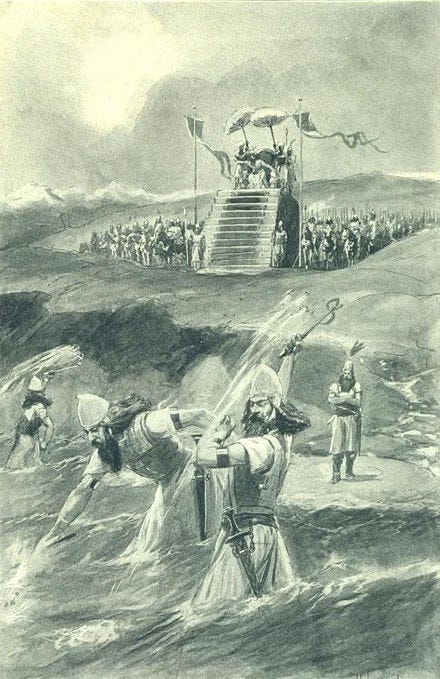

“Whipping the Hellespont” symbolizes our impotent rage at forces beyond our control.
My last two posts explored the Little Red Schoolhouse (LRS) method for clear and persuasive writing:
You may be wondering why I spent two posts discussing a form of human expression—writing—that seems to be in the process of becoming obsolete. Was I just whipping the Hellespont? After all, students can get chatbots to do all their assignments for them. And adults now have myriad AI tools for every writing task imaginable. Why bother writing anymore?
Make It Hard
To answer that question, let’s start with a joke:1
A Rolls Royce pulls up in front of a grand hotel, and a rich old lady gets out, leaving her adult son in the back seat. She pays several hotel employees to pull her son out of the car and carry him into the hotel.
A man standing nearby sees the whole thing. He says to the lady, “I’m so sorry that your son can’t walk!” and the lady replies, “Oh, he can walk, but thank God he doesn’t have to.”
Modern technology is designed to remove effort and friction from our lives, sometimes at the cost of activities that we enjoy, that connect us with other people, and that would benefit us in the long run. We no longer need to plan, shop for, and prepare our meals. Door Dash will take care of it. We no longer need to figure out how to get somewhere and drive there, or share space with other people on public transportation, or make conversation with a cabbie. Waymo will take care of it. And, apparently, our kids no longer need to struggle through learning to write clear and coherent arguments. ChatGPT will take care of it. We can have friendly conversations when we’re out and about. We can cook, drive, write (and walk). But thank God we don’t have to.
But can we though? As I have argued before, we human beings are active, social creatures. We learn by taking on challenges, making mistakes, and accepting help and adopting ideas from other people. Frictionless technology saves us from having to do hard things, with the possible result that one day we may not be capable of doing them at all.
Process, Not Product
Technology’s advocates seem unaware of the point of education. Much as we love our kids, and gifted as they are,2 they’re not Mozart. (Sorry, I tell it like it is.) The goal of school is to help kids discover and develop their interests and talents so that one day they can make a contribution that is all their own. But for this to be possible, kids need to put in plenty of work, on their own and with teachers and classmates. We adults need to be ok with them messing up before they get good.
A couple of months ago, WNYC’s Brian Lehrer interviewed the New Yorker writer Jessica Winter for “AI Creeps into the Classroom.”3 Winter was concerned that
Chromebooks are nearly ubiquitous in schools. Now they come installed with this suite of AI tools that is constantly giving kids prompts. Let the tool help you write, or beautify your slideshow, or whatever the case may be. I was really dismayed.
. . .
I don’t think that a child needs to be told that technology is here to make their work more impressive.
In response, a woman who works as an “AI literacy advocate” called in to argue that AI tools help children as young as preschool by “enhancing their ability to realize a narrative. . . . They may have greater capacity with the tools.” And Winter asked, quite reasonably, why elementary school children need “that greater capacity”:
How does that benefit them in terms of motor skills, in terms of working memory, in terms of relying on themselves, their own creativity, their own inner resources, and not outsourcing these beautiful gifts to a machine?
In Which I Tilt at Windmills
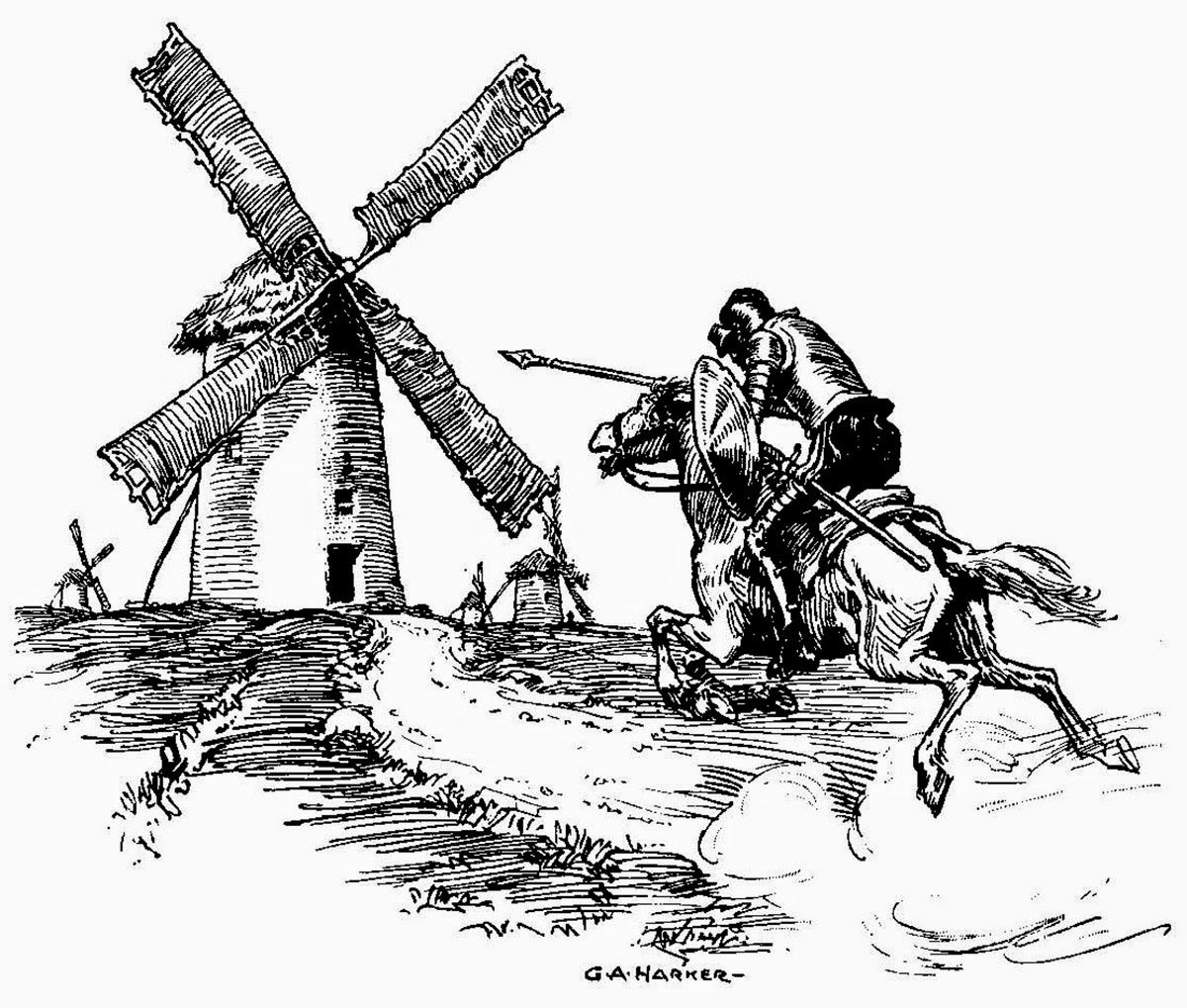

“Tilting at windmills” usually refers to wasting one’s energy on a quixotic quest. But I prefer the interpretation that we should “Stand for something, perhaps, most importantly when people think you are ridiculous.”
Accordingly, here I go defending that most hated of all literary genres, the five-paragraph essay. True, as a former English teacher I am biased. My college LRS students wrote a five-paragraph essay every week, and my high schoolers had to write as many as ten five-paragraph essays in a single year. It sounds like a lot (especially for the teacher who is grading them!), but the essays were short—only two to three pages. And because the assignments were so frequent, my students could practice and improve several cognitive and social skills:
Imagining other people’s perspectives,
Coming up with original and interesting topics for discussion,
Dividing those topics into three logically connected sub-topics,
Providing evidence to support their arguments,
Following instructions,
Planning and organizing their time,
Persisting with a complicated task,
Checking over their work and revising when necessary (hint: it’s always necessary),
Accepting criticism with resilience and resolve, and
Applying what they learned to future assignments.
Society benefits when the younger generation develops conscientiousness and the ability to think critically, acknowledge other points of view, and communicate with those who are different from them. But if we want these benefits, we need to let—or make!—students develop their skills by doing their own writing.
We Are the 99 Percent
A few months ago, I argued that the tech bros who have invented frictionless technologies are unusual. They are highly intelligent and thus don’t need to struggle and practice, on their own and with others, the way we do. Worse, many of their public comments indicate that they are not interested in social connections, or at least not in the way the rest of us are. Take Mark Zuckerberg. Please. His company is creating AI therapists, girlfriends, and friends because, as he said in a recent interview,
The average American has fewer than three friends, fewer than three people they would consider friends. And the average person has demand for meaningfully more. I think it’s something like 15 friends or something. At some point you’re like, “All right, I’m just too busy, I can’t deal with more people.”
. . .
So I think a lot of these things [AI “friends”]—things that today might have a little bit of stigma around them—over time, we’ll find the vocabulary as a society to articulate why they are valuable, why the people who are doing them are rational for doing it, and how it is actually adding value to their lives.
To me, this is evil. It’s literally dehumanizing. An AI chatbot is not a substitute for a human friend. Other human beings are not “friction” slowing us down as we busy ourselves with our important tasks. If Americans are too busy for friends, the solution is not to get rid of the friends; it’s to get rid of the excessive busyness. We are a rich country. We could simply decide to make it illegal for businesses to expect such grueling hours that workers are left too exhausted for anything but collapsing at home in front of a screen. We could pass labor protections—for example holding employers to a forty-hour work week for salaried workers, ending just-in-time scheduling for hourly workers, and requiring paid sick and family leave nationwide.
It can feel like whipping the Hellespont to wish that our tech overlords would go against their economic interests and use their power to campaign for less time alone in front of screens and more time together in the real world. But while we can’t control other people, we can control ourselves. AI is not the Hellespont, and we don’t have to whip it. We can walk away.
We can refuse to allow AI to invade and degrade all that makes us beautifully, uniquely human. We can refuse to let it desecrate our souls. We can meet up with friends face to face. We can take on challenges instead of taking the easy way out. We can write it ourselves. But first we need to let go of perfectionism. After all, what truly matters in writing, as in life, is not polished, pristine, palatable perfection, but that we have made others think and laugh, taught them something new, drawn them in, and touched their lives.4
Most of all, we can insist that the kids in our lives engage in the hard work of learning and growing. Yes, that includes writing those five-paragraph essays. Because, as Freddie deBoer says in “You Can and Should Blame Young People When They Act Like Lazy Cheaters, Actually,”
real blame, the kind that says “you did this, you’re better than this, and I am holding you to that,” is at heart an assumption of dignity, the refusal to give up on someone. . . .
So, yes. I blame the students, when they cheat, when they stick the prompt in ChatGPT and then look the professor in the eye and pretend they wrote it themselves. I blame them and you should too, if you want the best for them. Blame them as a form of respect, blame them and then help them, blame them and then build something better.
How about you, readers? What is something you love doing, even though it is difficult? How do you feel about the use of AI in education? Please share your thoughts in the comments!
The Tidbit
It’s week two of our unofficial Eagles music festival! My favorite Eagles song is “Seven Bridges Road.” In this live version, there are no studio tricks, no backing track, no autotune, nothing to hide behind, and certainly no AI—just glorious voices and astonishing virtuosity.
No, not “That’s what she said!” Get your minds out of the gutter, readers!
I once knew a pediatrician who began every conversation with families who were new to his practice as follows: “Of course, your child is very advanced.” He found that saying this made parents more receptive to his recommendations.
The transcript of this conversation is no longer available on the WNYC website. (I accessed it through the app.) The quotes come from the first ten minutes of the conversation.
Some people are even allowing AI to infiltrate such sacred moments of human connection as weddings and funerals. They’re delegating the writing of their wedding vows and even obituaries of family members to AI. What a sad waste of an opportunity to share authentic feelings. I wrote my dad’s obituary with help from my mom and brother. During the process, we shared memories, laughed, and grieved. You can read the expanded version, “An Everyday Hero,” here.
My high school teacher husband is spending his summer rewriting next year's lesson plans and tests so that his classes (and students) will be completely off-the-grid. A majority of kids feel pressured into using AI even though most of them don't want to (so the studies tell us, but don't ask AI as you'll get a different result). And the adults I know outside of my IT team at work feel pressured into using AI even though we hate every single thing it represents. AI should be used to make the world better, like, you know, curing cancer and whatnot. Using it for creating a grocery list? egads.
Also, at a communicators conference I attended a few weeks ago, there was a thoughtful AI breakout presented by an English prof who outlined when using AI is "useful" (aka allowable as long as her students cite) such as for brainstorming a topic or creating an outline, and when it is not, like using Grammarly which will rewrite rather than check content. We watched two commercials -- one generated by AI and one created by humans -- that illuminated the stark differences between what AI does and what humans can do. Until AI becomes sentient (which is likely will) it cannot outperform humans in creating competent, tangible, engaging content. AI doesn't have the human spark.
And we haven't even touched on the political forces behind AI (also, dare I say, lacking the human spark) and the so called energy centers that, at best, squander precious resources, and at worst, will destroy what is left of our fragile planet.
I lived in an area with a certain amount of striving by parents. The Texas worship of sports kept it kind of real, ironically. No matter how smart you thought your kid, the social atmosphere was always going to most reward “fit and athletic - and pretty”. Hardworking kids were as likely to get into elite schools (and get the scholarship to make it feasible) more on the basis of athletic prowess, or occasionally singing ability, than intellect. Which was fine and preserved a certain balance.
In fact, so important to the community was football that people in the area whose kids had long since graduated or even childless folks would attend the local high school games. I remember having only a small child and being asked, was I going to the game? I was surprised because I never really even attended my own high school’s football games.
Nonetheless, even in this milieu of success and anti-intellectualism I noticed at one point in the shopping center around the corner from my house a new storefront whose offered service was “balancing your baby’s brain”.
I’m ashamed now that I didn’t think to get together a brigade with pitchforks to drive out this sorcery.
As to the many services available locally, as a frugal person I marveled at them all, especially those connected to female beauty. But none - not even the one that would come by and wash out your trash bin for you, close cousin to the one that would come by and scoop the dog poop out of your own backyard - baffled me more than the local business that would teach your child to ride a bike.
Where I’m going with this: in reference to cooking being superfluous because “you can DoorDash” - I don’t plead that there’s necessarily any particular virtue* in cooking for yourself, or doing any other task - and depending how you go about it it could be just as expensive as DoorDash. Some people grill steak multiple nights a week, or prepare fish flown-in from the Pacific.
But although most of one’s friends are probably in “the 5%”, or “the 2%”, owing to unique recent history - the way to have money and keep money is not to never develop the capacity to feed oneself. To DoorDash, in short.
I don’t think anything about that truism has changed for 99% of us, even if you got in on the SpaceX IPO the other day.
I know it’s tacky to talk about money but it’s there. Even if they have been insulated by their (comparative, world-historical) wealth from thinking about it much, it is no one’s hope that their kids will not have a job because of AI. It is no one‘s hope that the jobs that will be available will be either, be a visionary entrepreneur (Mozart, Musk) or be a sweeper. It is no one’s hope that their kids will ever not be *alright* money-wise. I think the creative and indeed cognitive deficits created by a misplaced reliance on AI are important, and ultimately the most important thing; but I think going straight to them skips over what the profound effect on the structure of society will be. I think the future is going to be very harsh.
*I’ve always disliked the story of Mary and Martha, having felt it as curiously exclusionary - one of the few direct call-outs in the NT. It is probably something I need to hear, I readily acknowledge that. But Martha is stubborn. She is never going to hear. The good news is not for her.