
"Could Prove Harmful"
We're Worried about the Wrong Things

Articles don’t typically begin by contradicting their subtitle, and yet here I go: Yes, most of our worries these days are legitimate. We’re about to get bogged down in an Iraq-style quagmire in Venezuela. European countries are planning to deploy warships to protect Greenland against Trump’s threatened depredations. Our leaders apparently believe that ICE agents hold the power of life and death over us.1 It can feel pretty hopeless.
Current events are getting me down, and so I’m not going to write about them today. Instead, I’ll argue for a change we can make in our own lives that will fortify us to take on our many challenges. When we let go of misplaced worries and reject perfectionism, we free ourselves to take comfort in ordinary pleasures and harmonious relationships.
This topic has been on my mind recently because some environmentalists have been inveighing against pets. Why? Because, according to an article in the AP, pets contribute to greenhouse gas emissions.2 Fair enough; pets are living beings who exhale carbon dioxide. Plus, most of them eat meat. Although dogs will eat pretty much anything,3 they do need some meat in their diets, and cats are obligate carnivores. If cats don’t eat meat, they will die.

We’re worried about the wrong things. Whatever these environmentalists think, pets are not a major cause of climate change, and we won’t solve it by depriving ourselves of the love and laughter that our pets give us.
January is an abstemious month that is rife with health perfectionism—the subject of the rest of this post. Many Americans meticulously pore over health guidelines, strictly monitor their diets, seek out magical “superfoods” and shun “toxic” ones, and anxiously ruminate about their health. But to be truly happy and healthy, we actually need . . .
Less Cortisol and More Oxytocin
Anxiety about our health elevates cortisol levels, which can lead to chronic inflammation. Our worries are often misguided anyway, given that the recommendations keep changing. Back in the eighties, everyone dutifully avoided fat and ate lots of carbs, which we now know can cause insulin resistance, obesity, and type 2 diabetes. Health experts used to warn us that eggs were loaded with cholesterol, and so we should limit ourselves to egg whites or factory-made artificial eggs. Now eggs are touted as a source of healthy omega-3 fats. A few years back, everyone was adding turmeric to their food to benefit from its antioxidants—until, that is, we learned that powdered turmeric often contains lead.
I could go on. As an inveterate lover of dairy products, I was delighted to learn that according to a couple of recent studies, eating butter, cheese, and other full-fat dairy products leads to better heart health, and eating high-fat cheese is “associated with a reduced risk of all-cause dementia.” Those of us who refused the watery skim milk and trans-fat margarines that health officials foisted on Americans back in the eighties ought to feel vindicated.
And now RFK Jr. and the FDA have literally turned the food pyramid on its head. The new recommendation is for red meat and plenty of it. People are getting very het up about this. As a vegetarian, I do wish that everyone ate less meat,4 but not for health reasons. It seems at least possible that red meat, when consumed in reasonable amounts, is like eggs—better for us than we’ve been told in the past. And even if beef and pork aren’t health foods, some people really enjoy them, and that’s ok. Instead of fussing over what we and our loved ones eat, why not raise our oxytocin levels by enjoying a peaceful meal together?
We’re worried about the wrong things. Excessive obsessing about health can cut us off from the benefits of delicious foods and relaxed socializing with others.
The Weather Report from Hell
No, I’m not referring to my alma mater, or to the comparatively temperate winter weather in our part of Switzerland.

I mean that Hell must have frozen over because I actually agree with Dr. Oz about something:
Alcohol is a social lubricant that brings people together. In the best-case scenario, I don’t think you should drink alcohol, but it does allow people an excuse to bond and socialize, and there’s probably nothing healthier than having a good time with friends in a safe way.
While this remark has drawn almost universal condemnation, and while the evidence is overwhelming that drinking too much, driving drunk, and drinking during pregnancy are all dangerous, it is also true that socializing together, with or without a drink, is good for us, body and soul.
Here’s a story to illustrate what I mean: A couple of years ago, I was on a flight from Dulles to Zurich. We had boarded and were waiting to push back when the pilot announced that there was a problem with one of the engines and that we’d all have to get off the plane while it was being fixed. This was every bit as frustrating as you are imagining. Luckily, there was a bar near our gate, to which many of us repaired. Over beers, we strangers bonded. We joked around, commiserated, shared Swiss travel tips, and watched basketball. The mood was the exact opposite of what you’d normally see when a bunch of people are stuck in the airport for hours. Which makes sense: Drinking together is fun, and it can also alleviate stress.5
Reports of the dangers of the occasional drink have been greatly exaggerated. The former Surgeon General Vivek Murthy has claimed that “There is no safe level” of alcohol. But alcohol is not cyanide! The data show that although heavy drinking is unambiguously bad for us, light drinking at worst might very slightly increase the risk of developing some cancers. Derek Thompson strikes the right balance, in my opinion. He argues that warnings about the dangers of moderate drinking are “built on flawed studies and potentially overconfident conclusions.” He also offers a helpful way to think about risk and pleasure in our own lives:
Every drink takes five minutes off your life. Maybe the thought scares you. Personally, I find great comfort in it—even as I suspect it suffers from the same flaws that plague this entire field. Several months ago, I spoke with the Stanford University scientist Euan Ashley, who studies the cellular effects of exercise. He has concluded that every minute of exercise adds five extra minutes of life.
. . . For moderate drinkers, every drink reduces your life by the same five minutes that one minute of exercise can add back. There’s a motto for healthy moderation: Have a drink? Have a jog.
Or, to return to the topic that opened this post, we could pet a cat (or a dog):
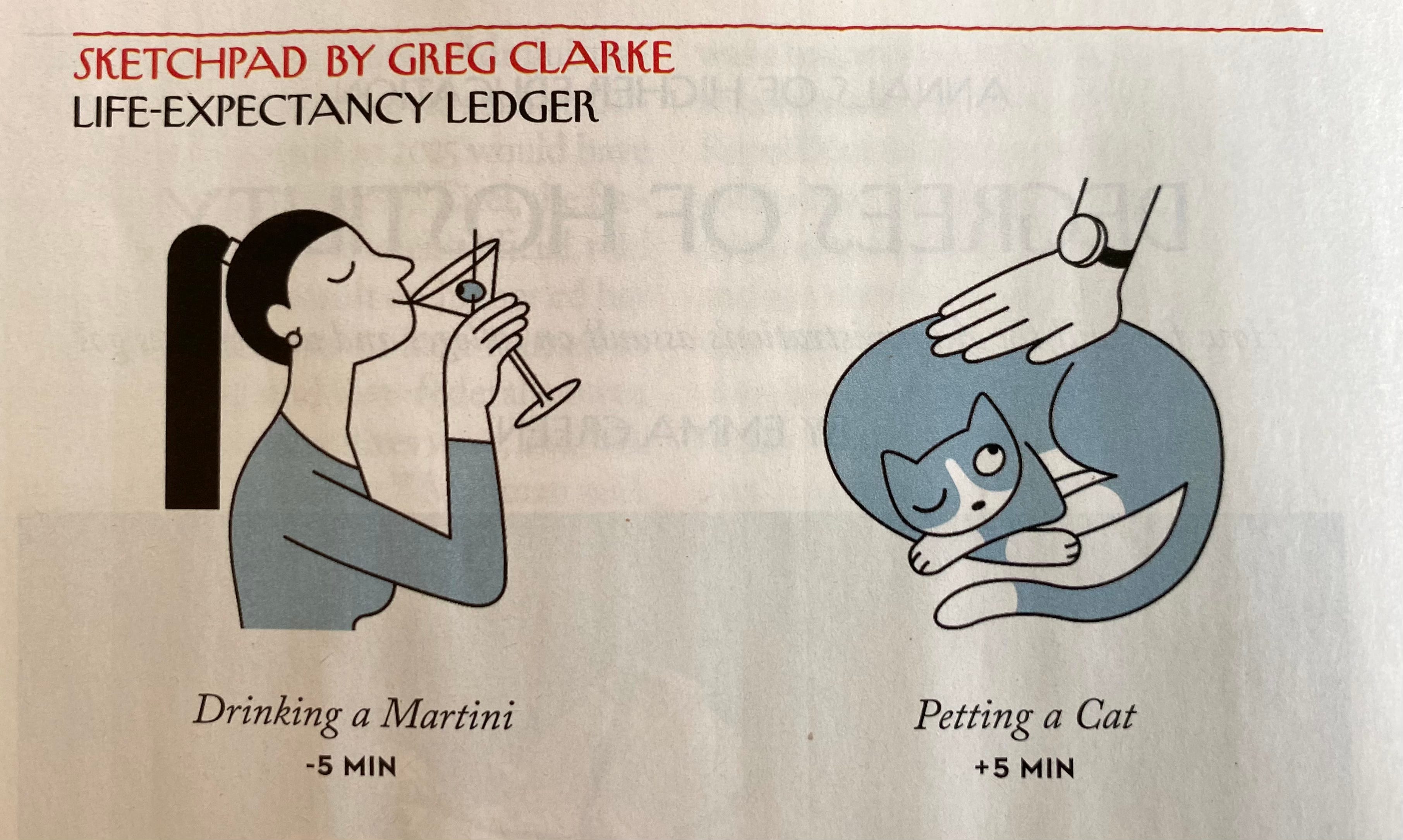
We’re worried about the wrong things. Out of fear that what we consume “could prove harmful,” we close ourselves off from restorative social connections and the simple pleasures that make life worth living.
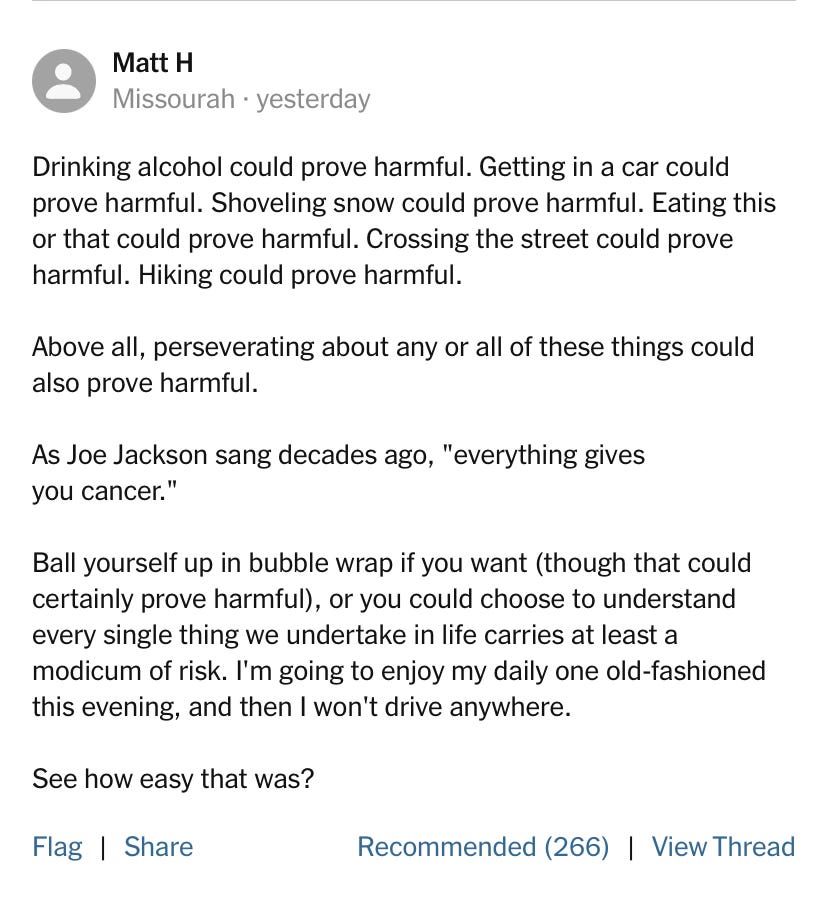
Pace the Bryan Johnsons of the world, human beings are not immortal. We are all going to die, even if we forgo such treats as butter, cheese, red meat, alcohol, sugar, or (if we’re in Switzerland) a McExtreme:

So I say, don’t worry. Be happy! Let’s round up some friends and raise a glass to less perfection and more enjoyment this year. And then, strengthened and renewed, let us face our challenges together. Onward!
How about you, readers? What are your indulgences that you enjoy too much to give up? Please share your thoughts in the comments!
The Tidbit
One of my favorite childhood memories is of the Dream Bars my mom used to make for her bridge club (and share with us kids). Bars are a Minnesota specialty and a potluck staple. They’re much easier to make than cookies. You just press the batter into a large pan and bake everything at once, no fuss no muss. Whether we like crisp or soft cookies, bars have us covered: The edges are crisp, and the center is wonderfully chewy and gooey. (Can you tell which I prefer?)
Below is my mom’s recipe, which I have slightly adapted and rewritten. A warning: The ingredients include the dreaded carbs, butter, and sugar. But go ahead and indulge anyway, preferably with a group of friends over cards, crafts, or coffee. There is more to health than fretting over “sinful” foods. Spending time together does the heart good.
Mom’s Dream Bars
Ingredients
For the crust:
1/2c softened unsalted butter, plus more for the pan
1/2c packed dark brown sugar
1-1/2c flour
For the filling:
3 eggs
1-1/2c packed dark brown sugar
1/4c flour
1tsp baking powder
1/4tsp salt
1tsp vanilla
1-1/2c flaked coconut
1-1/4c pecan halves (or more, to taste)
Method:
Preheat the oven to 350F and lightly butter a 9 x 13 baking pan.
When the oven is hot, spread the pecans on a separate baking sheet and toast them until they are fragrant and dark brown. (Don’t start scrolling on the internet while the pecans toast, because you will forget about them and they will burn. Ask me how I know this.) Remove the pecans and cool on a rack.
To make the crust, cream the butter and the brown sugar together until light and fluffy. Stir in the flour until the mixture resembles coarse crumbs. Press the crust firmly into the bottom of the baking pan and bake for about 15 minutes. Remove to a rack until you’re ready for step 7.
Meanwhile, in a small bowl, mix the flour, baking powder, and salt.
To make the filling, beat the eggs until they are foamy. (You can use the same mixing bowl from step 3—no need to wash it first.) Gradually add the brown sugar, vanilla, and dry ingredients and mix well.
Coarsely chop the pecans and add them and the coconut to the filling mixture.
Spread the filling over the crust and return to the oven. Bake for about 25 minutes until everything is golden brown but the center is still a bit soft. Cool on a rack for about 15 minutes and then cut into 24 bars with a wet, sharp knife.
Last week, Republican Representative Wesley Hunt responded to the killing of Renee Good as follows: “When a federal officer gives you instructions, you abide by them and you get to keep your life.” Good was a US citizen, and so ICE had no jurisdiction over her. In addition, Good was in fact obeying instructions. Before Jonathan Ross killed her, a different agent had ordered her to move her car. Not a single Republican elected official has condemned Hunt’s remark.
Kudos to the headline writer, though, for “climate pawprint.”
Except, for some reason, arugula.
I am a vegetarian because factory farms pollute the environment and cause terrible suffering to animals, and because unsafe conditions in meat-processing plants injure workers. But I have no problem with ethically-raised or hunted meat. In fact, we just gave our son Wagyu beef from Costco for his Hanukkah present.
I acknowledge that there are also plenty of cases of drunk people misbehaving on planes. But I suspect they weren’t limiting themselves to light social drinking.
Mari, I especially like your points about alcohol. The idea has proliferated that women with breast cancer. SHOULD NEVER AGAIN DRINK ALCOHOL. But the data does not support that conclusion. I read the studies after my own diagnosis and there was a clear connection between excessive alcohol consumption and breast cancer, but there just wasn't one for social drinking. However, the authors of the paper, wanting to be as provocative as possible, said that if they just continued the curve the way it had been going they could infer a connection between social drinking and breast CA. This actually makes me very angry and I would have put it in my book on breast CA, but didn't have the resources to do all the relevant research. However, if anyone with breast cancer is reading this, it's OK to keep having your glass of wine with dinner. My radiation oncologist confirmed that the data does not say what people, including physicians, are saying it does. And now that I think about it, this would be a great column.
I live in a city where many or most dogs are less for pleasure than for status and ferocity (nearly all pits), and male dogs are not neutered, as a cultural thing.
A cat person, pets have been a great pleasure - my husband once remarked that cats were one of the best things about living on Earth when we did -
except as they serially die and rip your heart out; I used to marvel at all the neighbors who were forced to use their lunch hour to return home to let out their dogs. But I figured the dogs gave them great pleasure at night when they were watching TV.
After a dog-less couple of decades my parents, despite my father’s grumbling, inherited my brother’s dog after a hurricane flooded him out. They also inherited the newer dog regime of: dog lives inside with you, your pal. That dog faithfully followed Mother around and was a marvelous companion to both, really a joy. It was adorable how, when they left the house and returned having forgotten something, they would find the dog had immediately taken my father’s recliner which it otherwise never got.
Not a real smart dog (King Charles) - he was a runner and once ran to a neighbor’s yard, jumped in their pool, and instantly began to drown, only didn’t because somebody happened to look out the window. But calm and content indoors.
A relative and her new husband had been married one month when they brought home a twice-returned “rescue” puppy. It seems like it’s made their lives much more difficult. Much running back and forth from work, or leaving events to run home and check on the pup, whom they can see crying on the camera. Travel will be trickier and less spur of the moment. I know all this is regarded as practice for having children, by some … and then there’s the expense. Fortunately everyone is rich now.
(He does not seem like he will ever be a chill indoor dog. To each their own. A sweet next door neighbor had 3 dogs, Katrina rescues, who never did stop going berserk if you came to their door; add in the yelling, er disciplining by her supposedly “alpha” husband and it just seemed easier to stay away. I learned later when they moved they’d had two cats cowering in a back bedroom the whole time they lived there - I was astonished, never knew!)
In some ways, pet ownership has grown more fraught in the USA because you can no longer leave your dog in the backyard. So the dog’s waste rules people’s life like the Divine Office.
In my apartment I have a view of the life of an urban dog and it is dull-seeming.
There is an unresolvable cognitive dissonance in folks whose idea of leaving a light footprint on the Earth involves eating no meat (however mistakenly, cows in particular filling a grassland niche) while owning lots of dogs. Cat food is more worrisome to me, for other reasons.
Overall I used to hope that people’s feeling for cats and dogs was a laudable sentiment that would transfer to and protect wild animals but I know now that was foolish.
There are, Google tells me, 900 million to a billion dogs on the planet. There are 200-250,000 wolves. There are 5,574 tigers which will unavoidably go extinct. Last year, in North Dakota, something cool happened for people who dislike the Endangered Species Act: the Greater Sage-Grouse became extinct in that grassland state, so no one there need worry about it anymore.
Nonetheless, I’ve noticed the internet has golden retrievers trending, and I will definitely watch when prompted.