
The Long Line Law
Voter ID and the SAVE Act

On February 11, the House passed the Safeguard American Voter Eligibility (SAVE) Act. The act would require proof of US citizenship (a passport, birth certificate, naturalization certificate, or official US military identification card)1 in order to register to vote, as well as an approved photo ID in order to vote. As defenders of the proposed law note, 83 percent of Americans support voter ID. After all, voter ID is the norm in many other democratic countries.
Even though I am way over on the left, I have no problem with voter ID. I am persuaded by the argument that we need ID to drive, fly, stay in a hotel, buy beer, etc., and so it’s reasonable to have to show ID when we vote. However, I believe that voting with ID should be easy, the way it is in other democratic countries. Voter ID should not be a tool for voter suppression.

This Is What Democracy Looks Like
Other democratic countries make voting as easy as possible. Most automatically register citizens to vote. They allow vote-by-mail, and they schedule Election Day for the weekend so that people don’t have to miss work. Some countries—for example Australia and New Zealand—go so far as to make voting mandatory.
My friend Bodil describes voting in Sweden:
A poll card is sent to you automatically by post or to your digital mailbox. There is no need to register specifically to have the right to vote.
[You can] either vote in person at a voting location on the day of the election (which is always a Sunday to make it convenient for as many people as possible), or you can vote in advance at special locations or by post.
While, as Bodil puts it, “Obviously, everyone voting needs to bring identification to be able to vote,” Sweden makes it easy to obtain ID. Swedish citizens who lack an ID can have a family member of legal age who already has an ID attest to their identity at a passport office.
This straightforward process is typical in Europe. Here in Switzerland, for example, families register their children at birth, and citizens apply for their passports and identity cards online. These must be renewed every ten years. A Swiss friend describes a process that is characteristically Swiss:
It’s very well-organized.
You make an appointment online. You can usually get one within a week, and when you get there you never have to wait. There’s no need to bring documents, because it’s all online. The worker checks that your name, height, weight, and address are accurate, and then they take your picture right there. They mail your ID to you. It’s a really easy process.
A Heartwarming Interlude
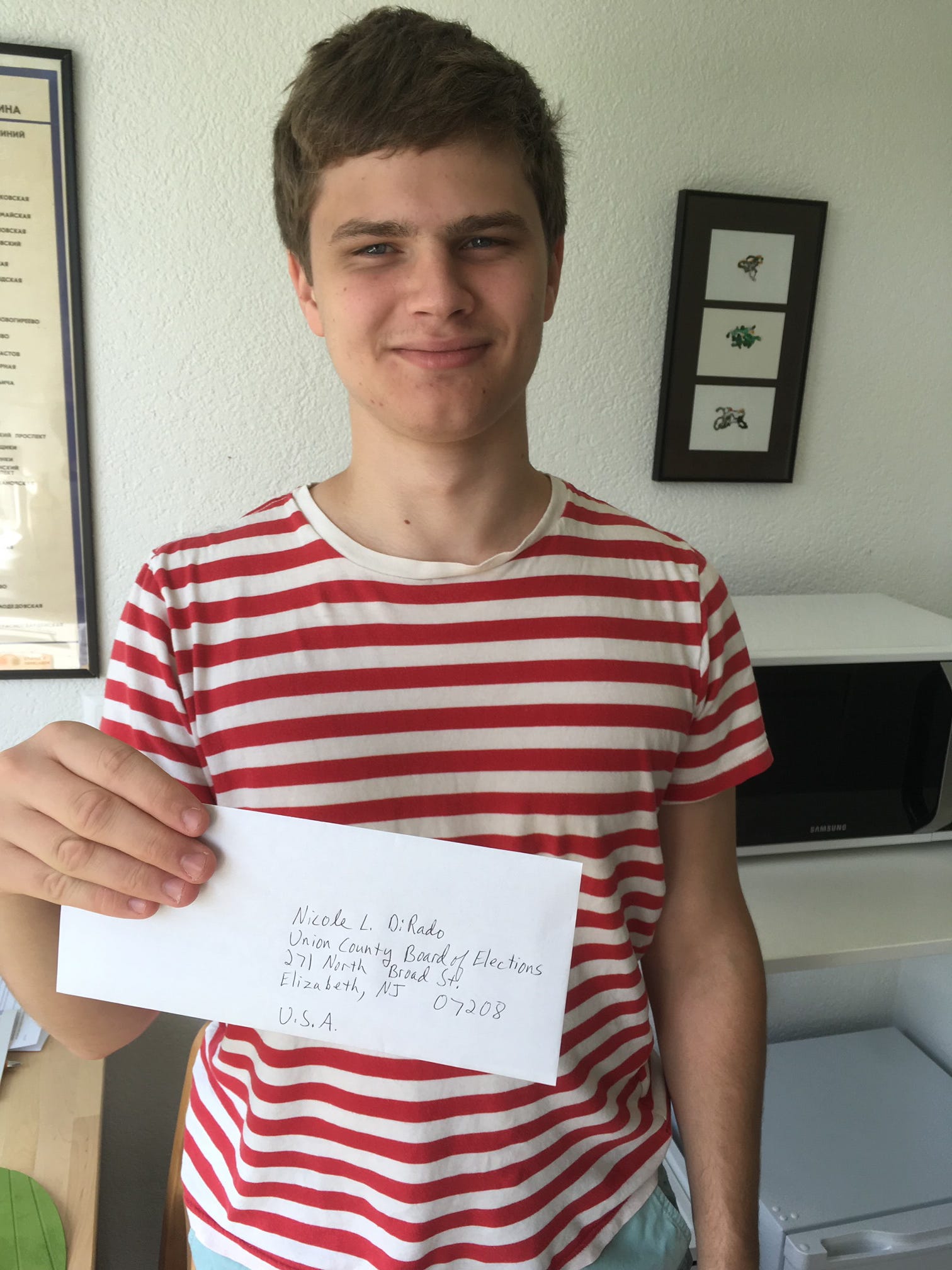
I have voted in every election since turning eighteen. And I do mean every election, including the time when the kids were little and we suddenly remembered half an hour before the polls closed that our small town was holding a city-council election. We rounded up the kids and raced to the polling place. Our candidate won by one vote! We even managed to vote after Hurricane Sandy caused power outages just before Election Day. Now that we live in Europe, we always vote by mail, using the last four digits of our SSNs as identification.
Matt and I are proud that our kids are committed voters too.
Why Are We Standing in Lines in Offices When We Have the Internet?
I think of the SAVE Act as the Long Line Law, because that’s what it would cause—long lines and unnecessary bureaucratic hassles. The act would likely require new voters and current voters who move or change parties to submit their documents in person, because it “would severely threaten mail registration and require online registration systems to be overhauled to fit the bill’s requirements.” It would also “shut down most community-based voter registration efforts.” All this at the very moment that DOGE has fired a large number of the government workers whose job it is to process our paperwork.
A greater hassle is obtaining the necessary documents in the first place if there are any discrepancies. This is personal: My official documents don’t match my birth certificate, because I go by a nickname and no longer use my middle name. When I got my first passport, my dad accompanied me to the office and signed an affidavit that Mari was the same person as [real name], and I built all my subsequent official documents off the passport. If I ever lose my passport, it will be difficult to prove that I am the person on my birth certificate. A lot of us are in the same boat, particularly married women who have taken their husbands’ names.
Cautionary Tales
If our government offices were as efficient as those in Switzerland, these extra steps would be no biggie. However, as the rollout of Real ID—which has taken twenty years and counting—demonstrates, our bureaucracy grinds slow, but it doesn’t grind fine. There is a reason we all laughed at that scene in Zootopia.
When Noah moved to DC a few years ago, it took two days and three visits to the DMV for him to get his DC ID. On the first visit, after a long wait, he showed his passport,2 birth certificate, and social security card, as well as an online copy of his lease (the only one he had) as proof of address. But the office required a paper copy of his lease or a bill to prove his address. So Noah saved his lease as a PDF and emailed it to his grandma, who printed out all 64-some pages. Back he went, sheaf of papers in hand, only to discover (after another long wait) that because it was a sublease, it didn’t count.
I was beginning to wonder whether the workers were expecting a bribe.
The next day, Noah took a screenshot of one of his bills, emailed it to his grandma, who printed it out, and back he went. After yet another long wait, the worker accepted everything, and Noah had his ID. Ta da!
A friend I’ll call Elisabeth recently got her official documents in order and kindly allowed me to share her own experience with byzantine bureaucracy:
My name is spelled differently than most people expect. So that has complicated each of my three legal names. When I got married the first time, I took my husband’s last name and put my maiden name as my middle name. So two of the three names were different than my birth name. When I got divorced, I changed my name for the last time. I put my maiden name back in the surname position. Then I put a surname from my maternal line as my middle name.
I went through SO many hoops [to get accurate certified copies of my official documents]! Many of these hoops cost money. And twice I had to return to the local county office because years ago when they went digital with the records, THEY got the spelling of my name wrong. It was only because I had paper copies of my documents from the 1990s that I was able to prove they were wrong. And I had to ask to explain it to an older staff member who recalled the era of data entry from paperwork, who understood the human error involved.
Elisabeth notes that she had it easier than many people because she was able to drive to the county courthouse to obtain proof of marriage and divorce. People who don’t have access to a car, a printer (or an accommodating grandma), and seemingly infinite time are going to have trouble wending their way through such labyrinthine requirements.
I Am Woman, Hear Me Roar
At this point, some readers may wonder why I am characterizing women—and indeed all Americans whose IDs aren’t yet up to snuff—as incompetents akin to those hapless people in infomercials.
(Definitely watch the whole video. It only gets funnier as it goes on.)
As a conservative friend puts it,
The feminist movement has spent decades telling us that women are strong, independent, capable, intelligent adults who can do anything men can do.
And now we’re supposed to believe that these same women . . . will be completely defeated by the requirement to show a birth certificate and a marriage certificate when they register to vote?
Fair enough. I am a feminist, and I agree that women are fully capable of obtaining government documents and voter IDs, even when their path is made needlessly tortuous, and even when they are forced to expend more time, effort, and money than men in order to achieve the same goal. Like Ginger Rogers, we women are used to doing everything Fred did, only backwards and in high heels. So yes, if the government starts requiring a bunch of extra steps that some women must take in order to vote, we will do it. We are strong. We are invincible. We are women.
But it’s also fair to ask supporters of the SAVE Act, Why do you want to make voting difficult and expensive? The Pew poll linked in the opening paragraph shows that Americans overwhelmingly favor not only voter ID, but also easy and accessible voting: 80 percent support early voting, 74 percent support making Election Day a federal holiday, and 58 percent support universal vote-by-mail and same-day registration.
A Solution in Search of a Problem
Our current system actually functions remarkably well. The Cato Institute reports that “Recently, a number of states have undertaken investigations into noncitizen voting, cross-checking voter rolls with citizenship status, and found it virtually nonexistent.” Voter fraud in general is exceptionally rare, and certainly not a threat to free and fair elections in the US. The right-wing Heritage Foundation tried to find instances of voter fraud but had to go back decades and examine hundreds of millions of votes before they found any cases. For example, they examined 100 million votes in Pennsylvania over the past thirty years and were able to document a grand total of 39 fraudulent votes. Kind of embarrassing that they went to so much trouble for so little payoff, right?
The highest figures for voter fraud I could find are in a study by the Brennan Center for Justice, which reports rates of voter fraud “between 0.0003 percent and 0.0025 percent.” That’s between three and twenty-five votes per million—hardly enough to decide any election. (And note that this figure includes fraud perpetrated by both parties, so perhaps it’s all a wash.)
The SAVE Act would steal time and money from millions of innocent Americans and disenfranchise a significant number of us, all to prevent a handful of fraudulent votes. This hardly seems like a good trade—unless stopping certain people from voting is actually a feature, not a bug.3
Calling Their Bluff
It is possible to implement voter ID in a way that doesn’t suppress the vote. Here are a few ideas:
Allow citizens to access documents online and upload them directly to voter registration portals. There is no need for us to pick up documents in government offices, or wait for them to be delivered through the mail, and then bring them to other government offices to submit physical copies in person. We pay our taxes and conduct our financial transactions online. Surely the internet is also sufficient for voter registration and ID.
Hire more workers so that requests for documents, voter registrations, and acceptable IDs can be processed quickly.
Host sessions at churches, schools, community centers, etc., so that public employees can assist citizens who lack internet access with obtaining and uploading documents.
Waive fees for voters who qualify for the Earned Income Tax Credit so that the cost of obtaining documents isn’t prohibitive.
Just knock it off with the selective use of exact-match policies to keep certain people from voting. Hyphen or accent discrepancies shouldn’t eliminate our right to vote. Juan González and Juan Gonzalez are obviously the same person.
The Best Time to Plant a Tree


Our Constitution doesn’t require us to navigate between the Scylla of long work hours and the Charybdis of an intransigent bureaucracy in order to vote. We can have secure elections without voter suppression. The Senate is debating the SAVE Act right now, so it’s a good time make our voices heard. You can find your senators here.
It’s also time for all of us to get our documents in order, and to help our loved ones do so too. To paraphrase the parable about the best time to plant a tree, the best time to get your passport is twenty years ago. The second-best time is today. You can start here.
How about you, readers? How would you preserve both election integrity and voting rights? Please share your thoughts in the comments!
The Tidbit
Noah’s struggle to get his DC ID reminds me of this sketch. It’s funny because it’s true!
I am aware that if the SAVE Act becomes law, Noah can use his passport to vote. My point is that voters who don’t have passports may have to go through hassles like the ones described in this section in order to vote.
Incidentally, women who change their names after getting married skew Republican, people who have passports skew Democrat, and government offices are more accessible in dense urban (i.e. blue) areas than in rural (i.e. red) ones. So it is possible that the SAVE Act will disenfranchise more Republicans than Democrats. Which is also wrong!
I love the Ginger Rogers bit, and I've seen women in my life have to live out the truth of it.
I was at a car dealership with my wife at the beginning of our marriage. The salesMAN would not answer her questions directly, but spoke to me as if I had asked. This happened twice. Then we politely excused ourselves and left the dealership. Forever. We went across the road and bought a car from a less toxic male.
I swear, testosterone must be a brain toxin.
Good thoughts, Mari! I take issue with your conservative friend, though. Women are angry about the requirements of the SAVE act because it asks them to prove their identities in ways that men are not asked to. That’s discriminatory, not a symptom of us being incapable.