
Third Time's a Charm
Life Lessons from FINALLY Going to Cinque Terre

Long-time readers may remember that my husband, Matt, and I have a history of trying and failing to visit Cinque Terre, the five tiny villages perched on Italy’s Ligurian coast. It takes less than six hours to drive there; you’d think going would be a simple matter of hopping in the car. But we were twice thwarted. Our first trip was planned for the first week of April 2020. Man plans, and God laughs. Our second attempt was a couple of years ago. The night before we were supposed to leave, our dogsitter called to say that our then-dog, Lynn, had become deathly ill, so we canceled and spent the week nursing Lynn back to health.1
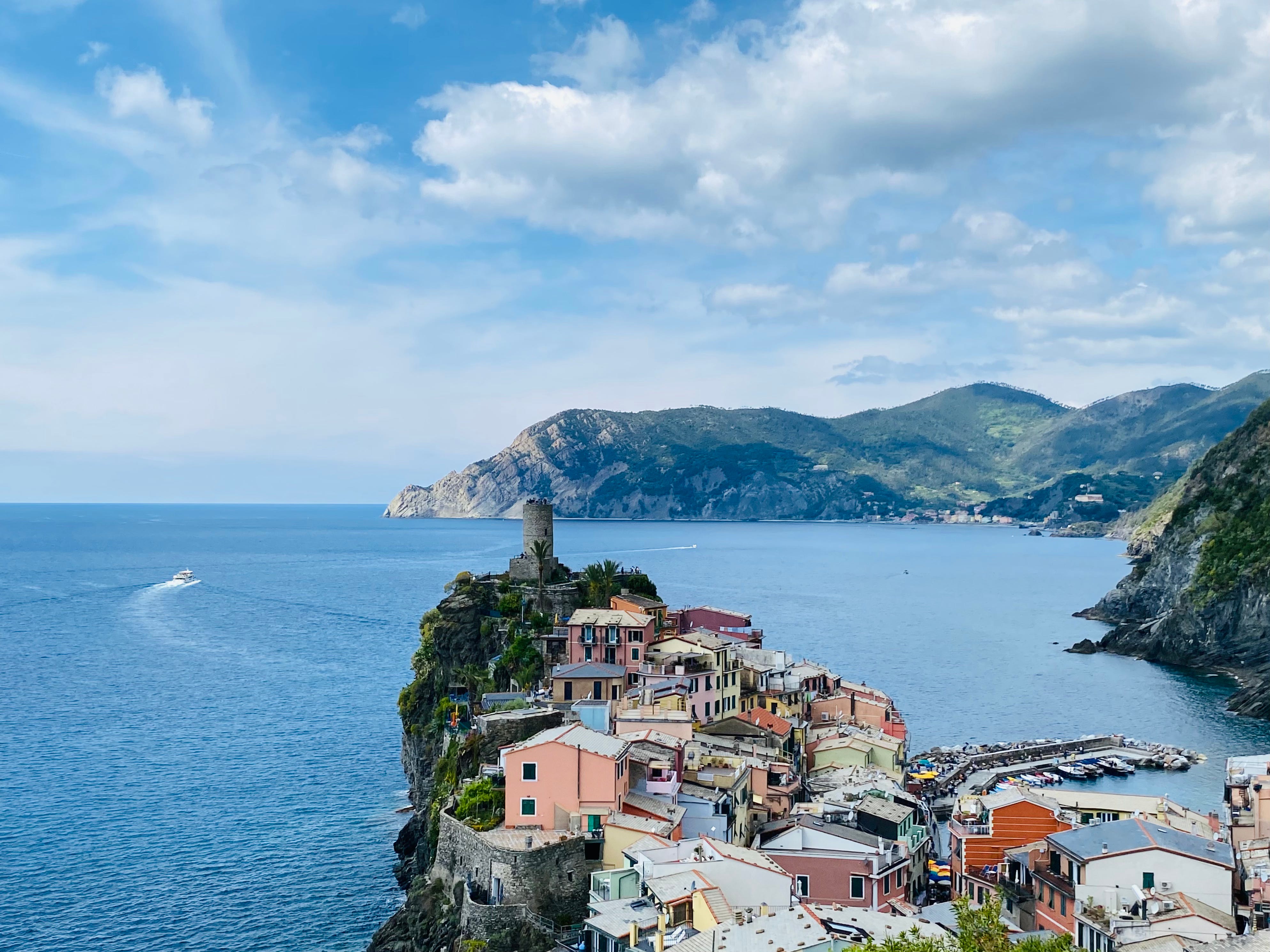
But third time’s a charm. Behold, Cinque Terre:
Monday morning, I dropped Lenny off at the Tierferienheim (“animal vacation home”) and then drove us to, around, up, and through the Alps.2 We emerged from the Great St Bernard Tunnel in sunny Italy and headed down the switchbacks to our first stop, Aosta. Aosta is a little city that is “lovingly set in the Italian Alps” and that boasts some of the best-preserved Roman ruins in the world. (“Aosta” is pronounced the way a Bostonian would say “ouster”—“OW-stah,” which makes me think of that skit where “Three guys from Boston say every town and city in Massachusetts.”)
The next morning, I drove us along some harrowing narrow roads to our home base for the remainder of the week. Matt’s Italian coworkers had warned us that Cinque Terre is horribly crowded even in the off-season, so we chose to stay in Sestri Levante, a pretty beach town that’s halfway between the busier areas of Cinque Terre and Portofino.
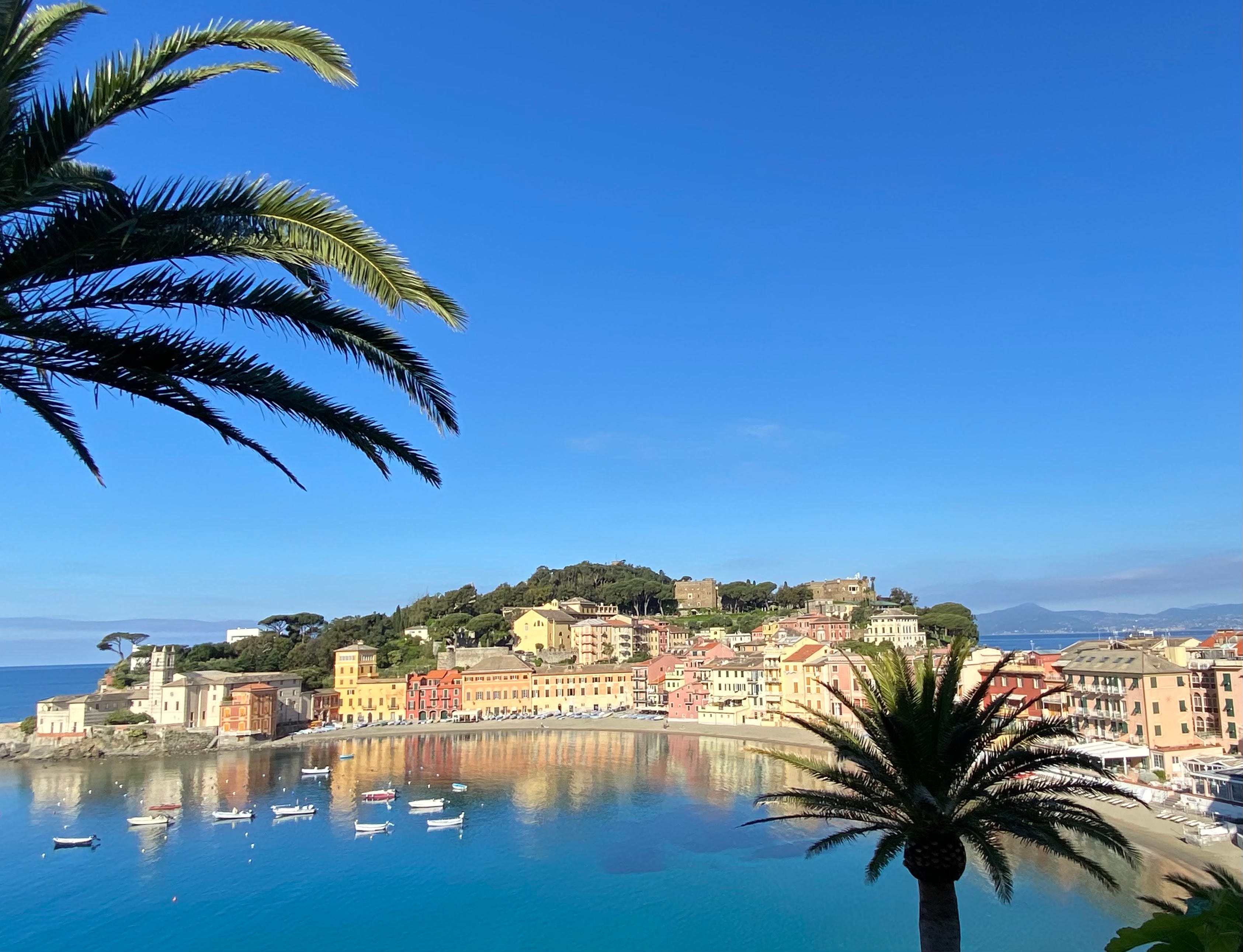
We were disappointed to discover that “Sestri Levante” doesn’t actually mean anything—or rather, as this article helpfully informs us, it means “Sestri of Levante.” Ok, noted. In my head-canon, the name “Sestri Levante” ought to mean “Levantine sisters” and derive from a local folktale about three sisters, in which the oldest sister is practical and clever, the middle one is plump and funny, and the youngest one is beautiful and kind.3
Anyway, as is my wont, I learned a number of life lessons during our week.
Worry is paying interest on a debt you may never owe.
Because the whole point of the trip was to hike, sit on the beach, and take boat rides, the weather was going to matter. There wouldn’t be any museums we could duck into on a rainy day, and much as I love cathedrals, even I can spend only so much time in them before my eyes glaze over. Matt and I spent the two weeks before our trip obsessively checking our weather apps. Their predictions kept vacillating between dire and delightful. Were they trolling us? Just in case, I packed both sunscreen and umbrellas. As it happened, we had truly spectacular weather for our entire trip.
Why did we spend so much emotional energy on something we couldn’t control?
“This is not when Italians eat dinner.”
Early one evening, Matt and I headed over to a top-rated restaurant where you can choose your dinner from a case displaying fish pulled from the ocean mere hours before. We were served free prosecco followed by an enormous and delicious vegetarian pizza (for me) and fried fresh fish (for Matt), all at a bargain price. Weirdly, the entire time we were there, there were no other customers. I asked our waiter what was up, and he answered, totally deadpan, “This is not when Italians eat dinner.” Fair enough.
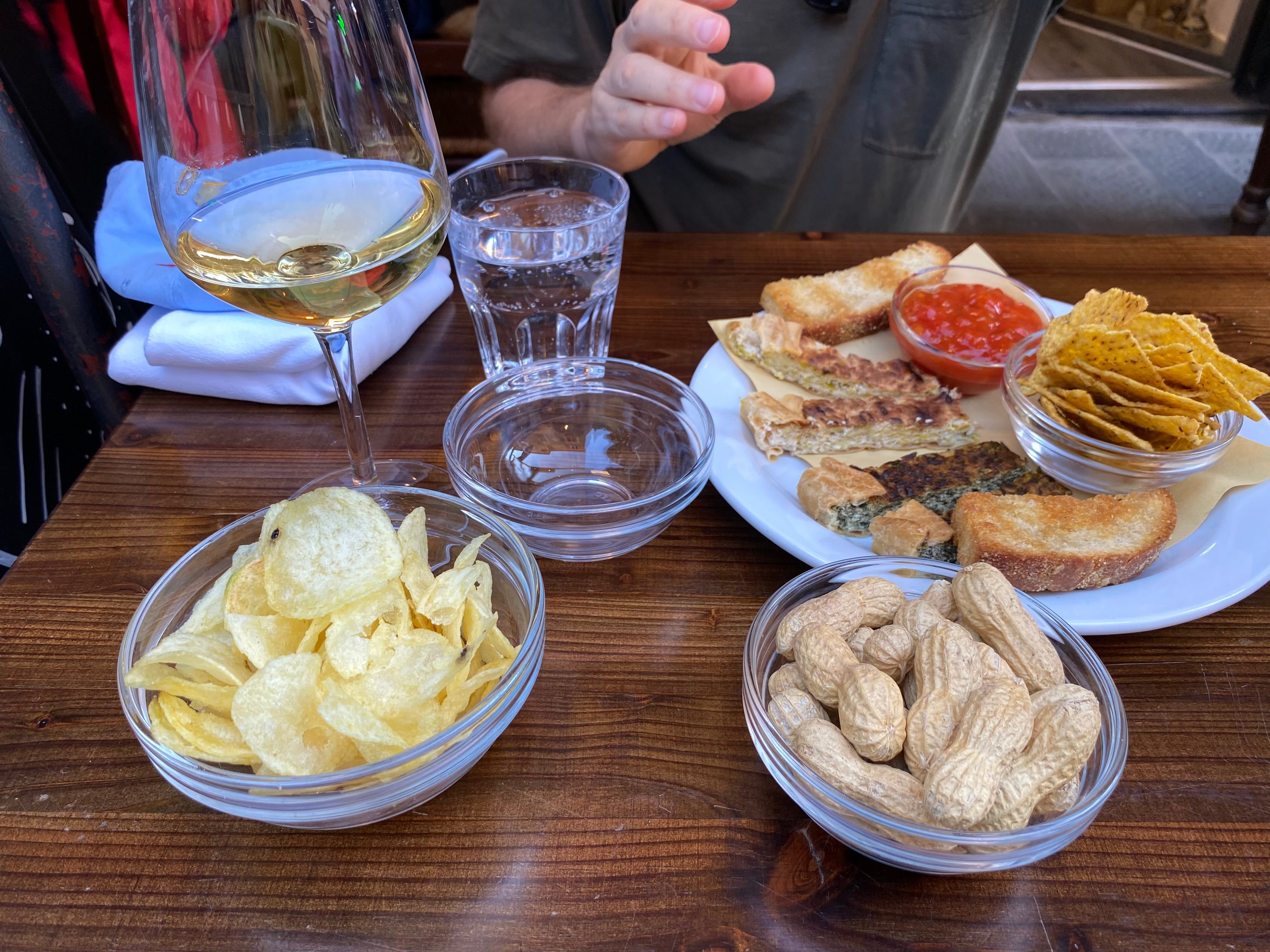
As I have argued before, it’s ok not to act like a local when we’re traveling. I am an insomniac and also an extremely early riser (5:30am most days), and so for me a late dinner comes at the cost of a couple of hours of sleep. It’s difficult to enjoy travel when we’re sleep-deprived! So in late-dining countries like Spain and Italy, I find workarounds, for example ordering a glass of wine during apéro hour and noshing on the free appetizers:
We did consider having dinner in a restaurant that sounded really special. Trip Advisor, Lonely Planet, and Rick Steves all raved about its delicious food, low prices, authentic vibe, and opportunity to rub shoulders with the locals.4 But the place didn’t open until 7:30pm, didn’t take reservations (and Trip Advisor warned that people start lining up around 6:45), and only served one vegetarian dish—pesto pasta, which I had already eaten twice during the trip and make at home (here’s my recipe) all the time. So we opted for something a little less special.
How about you, readers?
As with dressing for a formal event, so too with travel plans: Take one thing off.
While planning the trip, I showed my proposed schedule—including side-trips to Lucca and Carrara—to a friend, and she remarked, tactfully, “Wow, that’s ambitious!” She was right. After the terrifying drive down, I was in no mood for several more hours in the car, so we scrapped the plan to visit Lucca. And then a road closure put the kibosh on a trip to Carrara. A message from the universe!
Instead of cramming in more activities, we had a rest day hanging out in Sestri Levante. We took a morning walk and then decamped to a seaside bench, where Matt read and I knitted for a couple of hours. We greeted all the people and their dogs as they (respectively) strolled and galumphed along. Honestly, this was probably the most authentically Italian way we could have spent the day.
Corniglia: May its name be blotted out.
One day, we hiked from Monterosso al Mare, Cinque Terre’s northernmost town, to Corniglia, the middle town. We climbed up and down hills past waterfalls, vineyards, and olive and lemon groves, accompanied by the aromas of the sea, wet earth, curry leaves, and the honeysuckle perfume of Japanese Cheesewood. We were constantly awed by the stunning views surrounding us.
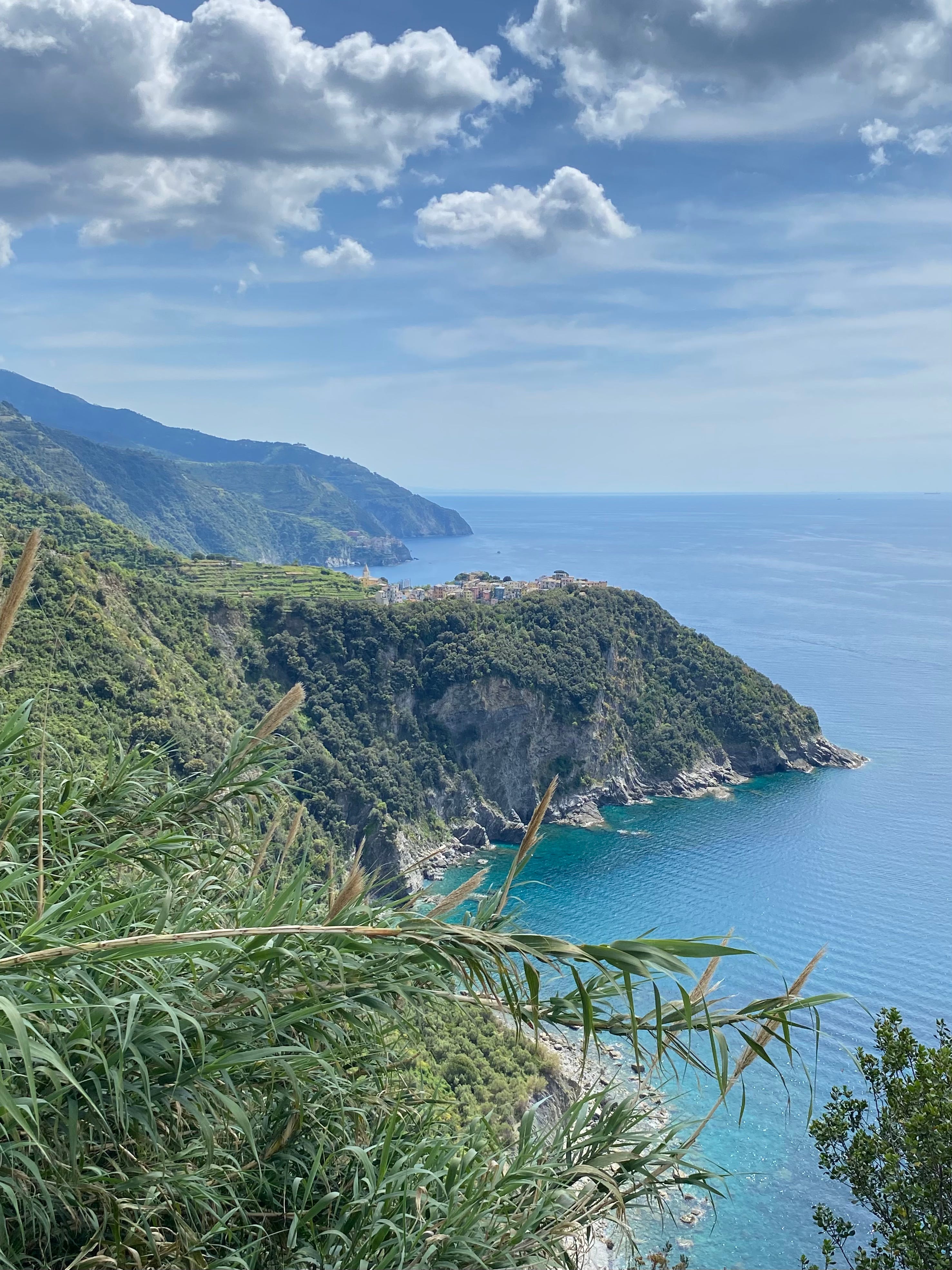
However, the end of the hike was less than awe-inspiring, to say the least. When one is properly hydrating on a hike, one soon discovers that one needs the bathroom, stat. Unfortunately, the public bathrooms in Corniglia were broken and locked. Matt asked several restaurants whether he could use their bathroom but was refused every time. So while I stayed in town to take in the scenery and also some gelato, Matt had to race all the way downhill to the train station bathroom, only to find a dozen or so people—who were likely also stymied by Corniglia’s bathroom situation—already waiting in line. Could those workers not have taken pity on Matt?
Matt is more fair-minded than I am; he pointed out that when there are millions of tourists passing through such a tiny place, staff can’t make exceptions to the rules for anyone, lest their bathrooms be (literally) inundated. An estimated 2.5 million people visit Cinque Terre every year, compared with only 3500 year-round residents. That is one heck of a ratio. It is understandable that the workers can be brusque and ungenerous with tourists. To avoid crowds, Matt and I usually travel to popular places during the off-season, but I still feel ambivalent about contributing to overtourism, especially in small, vulnerable places like Cinque Terre.
What do you think, readers? Is it ethical to travel to overtouristed places? Do you have tips for dealing with the crowds?
“It is impossible to stay in Italy and not drink the wine.”
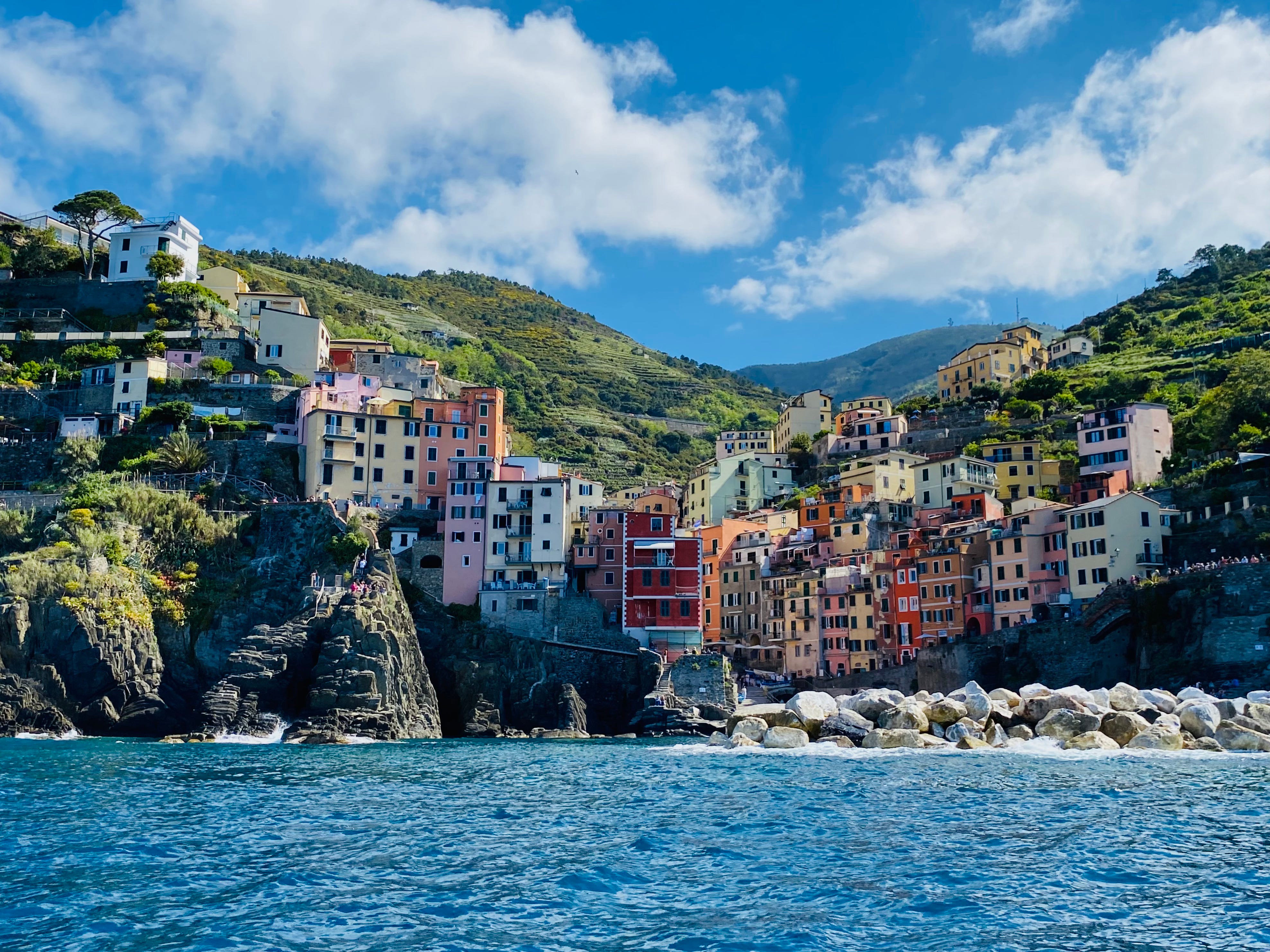
For our last day, we splurged on a private boat tour of Cinque Terre. As is the case with every private tour we have ever taken, it was well worth the money. Our guide, Stefano, showed us each town from a new perspective—the sea—as well as hidden caves, nineteenth-century tunnels dug by hand through the rock to vent coal smoke from trains, fascinating rock formations, and medieval-era retaining walls holding up terraced vineyards and farmland. (These retaining walls make up the second-largest hand-built wall in the world, behind only the Great Wall of China.) Halfway through the tour, at 11am, Stefano broke out the prosecco and quipped, “It is impossible to stay in Italy and not drink the wine.” Of course I drank up!
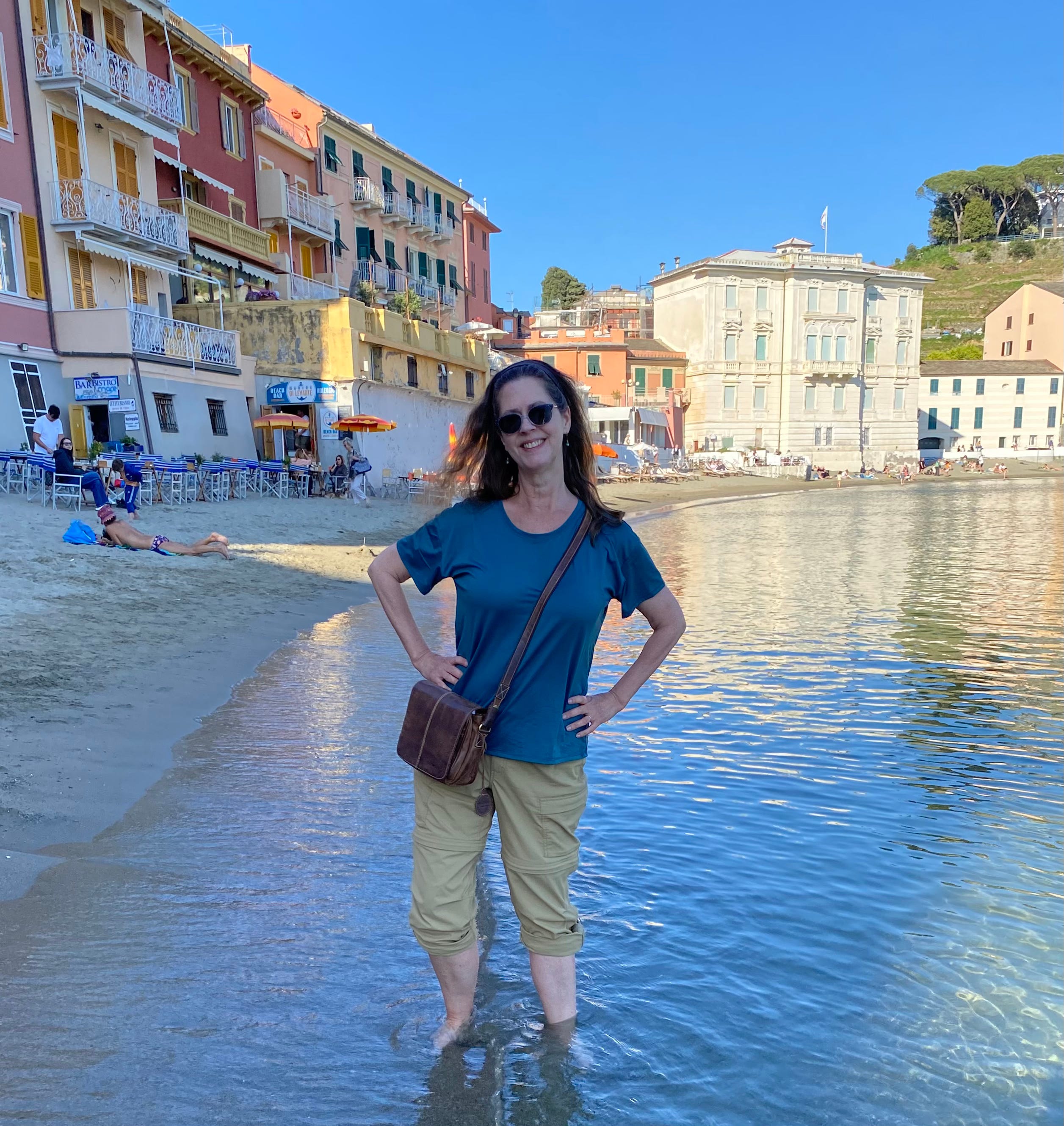
So our final lesson is that it is good to treat ourselves during our travels, and also our daily lives. Why refuse any opportunity to enjoy life’s blessings? Go on the private boat tour. Drink the prosecco. Buy the souvenir. Indulge in a fancy dinner. Pull a loved one in for a bear hug. And, if you’re me, wade in the water to give “The Love Song of J. Alfred Prufrock” a happy ending. Perhaps you, too, will hear the mermaids singing.5
How about you, readers? What life lessons have you learned from your travels? What is your favorite trip you have ever taken? Please share your thoughts in the comments!
The Tidbit
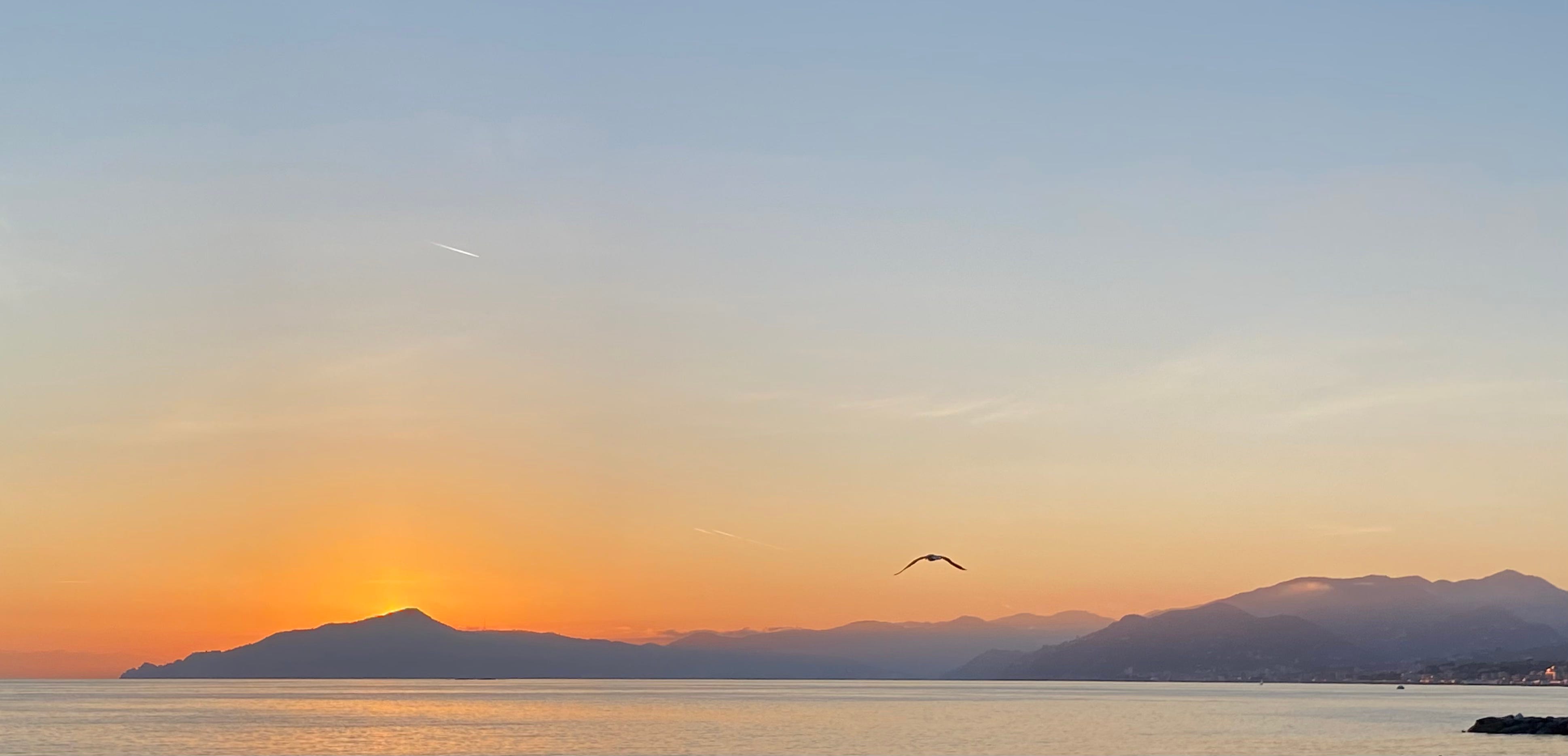
Ciao, Italia! We’ll be back soon!
Matt warned our new dog, Lenny, that we had canceled a trip to Italy on account of a dog for the last time, and so he had better stay healthy. Fortunately, he did!
I always do all the driving, not for feminist reasons, but because I love driving and Matt hates it.
Sigh. As an oldest sister myself, I have always wondered why the oldest sister in these stories is never the beautiful, kind one.
And I do mean literally rub shoulders: “Everyone shares long tables . . . [and] you can mix with the locals while enjoying traditional cuisine.” Rick Steves, Italy’s Cinque Terre (Berkeley, CA: Hachette, 2017), p. 140.
The beach in this photo was a favorite holiday destination of Hans Christian Andersen. Maybe this exact spot inspired “The Little Mermaid”?
Your trip looks so lovely, Mari. I'm so glad you finally got to go. What has been my best trip? Wow, it's so hard to say. I would say the safari we did was life changing, hiking in Grand Canyon is amazing, and I loved visiting Santiago. But I also remember an afternoon spent in Salzburg whiling away the time talking with friends in a coffee shop. That is a special memory, too.
On splurging for a special experience, here is Mark Twain, "Innocents Abroad," on how the group of American travelers he was with on the first U.S. group tour of Europe and the Middle East were wracked with disappointment at the Sea of Galilee in The Holy Land, when they tried to bargain-- unsuccessfully--for their one chance to sail on the oft-drempt-of sea: "pilgrims who had dreamed all their lives of some day skimming over the sacred waters of Galilee and listening to its hallowed story in the whisperings of its waves, and had journeyed countless leagues to do it, and--and then concluded that the fare was too high."